The newer estates out at Shell Cove, Calderwood and Horsley were set out to fit as many houses on the land as the land would take, which is why so many of them have a second-storey window looking down into somebody else's outdoor area from about four metres off. Nobody did anything wrong. It's just what those lot sizes produce, and it's behind most of the screen calls I get.
So the screen goes up. And the cheapest way to put one up, which is what nearly everybody asks for first, is to screw it straight onto the top of the Colorbond dividing fence.
Don't. Two reasons, and the second is the expensive one.
The dividing fence is half your neighbour's, so hanging anything off it is a conversation you have to have before it's a job. And a 1.8 metre Colorbond fence is engineered to hold up a 1.8 metre Colorbond fence. Put another 600mm of slats on top and you've built a sail. First proper southerly and the whole run leans.
The six-metre run at Shell Cove ended up freestanding, 200mm inside the boundary, on its own posts and footings. Cost more up front. Still standing.
What screens cost per metre
Around the Illawarra in 2026, supplied and built:
Treated pine slats on a simple frame, fixed to posts that are already there and sound, is the cheap end at roughly $250 to $400 a lineal metre for a screen up around 1.8 metres. That's the one people quote off the internet and it only applies when there's genuinely something solid to fix to.
A freestanding screen with its own posts and concreted footings, treated pine, is more like $400 to $600 a metre. The footings are most of the difference. A screen catches a lot of wind for something so thin, so the posts go deeper than people expect.
Spotted gum or merbau slats, dressed, on a proper frame: $550 to $850 a metre. That's what most of the ones you notice are, and the timber cost is doing the work in that number.
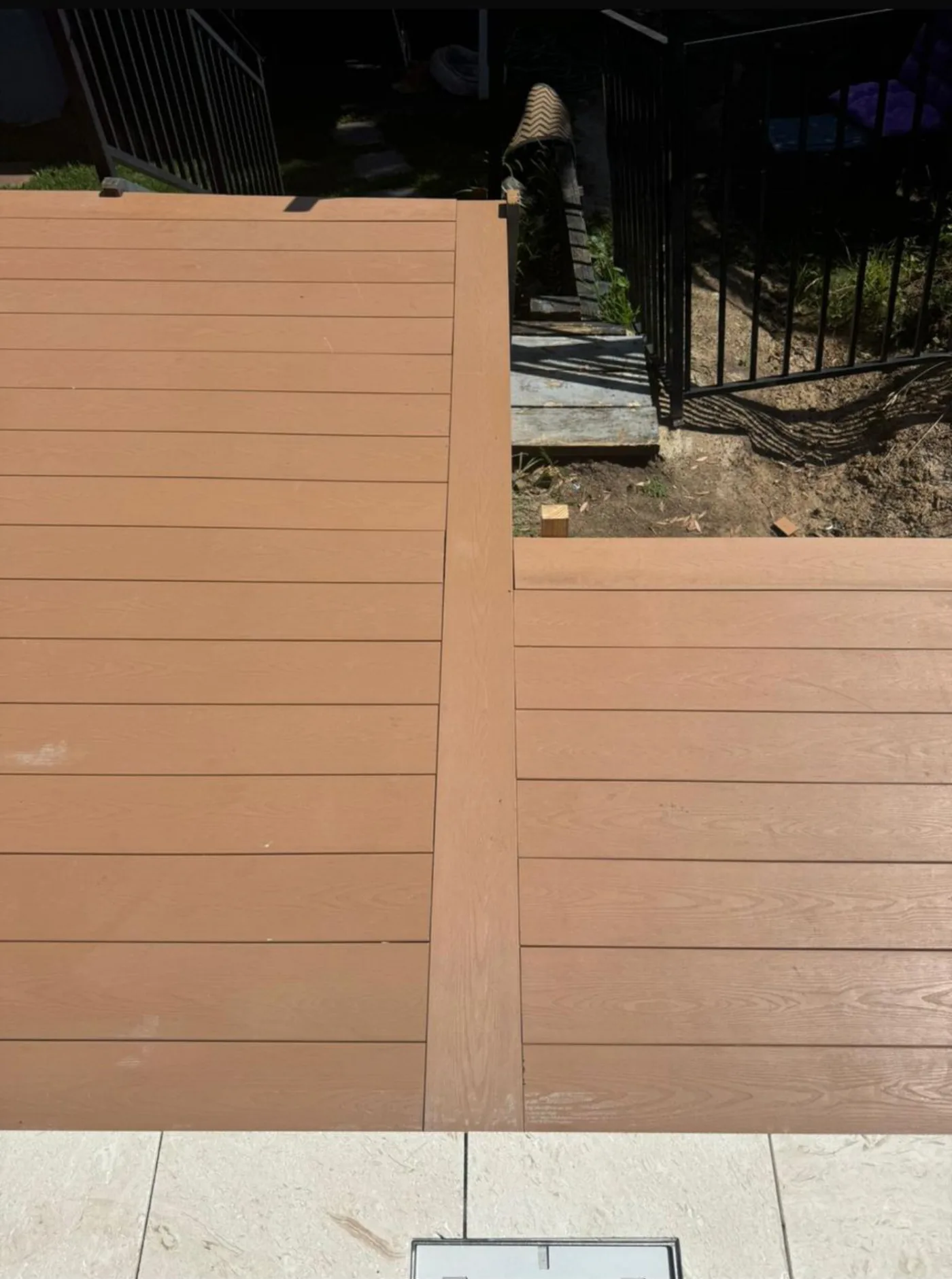
Composite or aluminium slat systems: $600 to $1,000 a metre. Dearer up front, and then you hose it once a season and forget about it. The same trade-off I go through in the merbau versus composite decking piece applies here almost exactly, except a screen is vertical so it stays cleaner and the argument for composite is a bit weaker.
For the single-panel job, which is honestly the most common one, a three-metre run to block off one window or one sightline lands somewhere around $1,200 to $2,500 built. Small job, but there's still a day in it and there's still concrete.
Why it costs more than a fence
People compare screen quotes to fence quotes and get a shock. A treated pine paling fence sits at $110 to $200 a metre, and I've got the full breakdown in the fencing cost guide.
Three things account for the gap.
Slats are individually fixed. A paling fence is palings nailed on in a run, quick and forgiving. A slatted screen has every batten spaced, levelled and fixed at both ends, and the whole point of it is that it looks deliberate. Uneven spacing on a screen is the first thing anyone sees.
The timber is better and there's more of it exposed. Fence palings get their back turned to you. Screen slats are seen from both faces, so they get dressed timber and both sides get finished.
And the framing has to be stiffer. A screen has gaps in it, which sounds like it'd catch less wind, and it does, but the frame is also carrying that load through fewer connections. Undersized posts on a screen show up as a lean within a year.
Spacing, which is the whole design decision
Gap width is the one thing worth thinking about before anyone quotes.
Tight spacing, say 10 to 15mm between 65mm slats, blocks nearly everything from straight on and turns a corner of the yard into a box. Not much light, not much air. Fine for a bin bay or a pool pump.
Wider spacing, 25 to 35mm, still blocks the sightline from a neighbour's window because they're looking across at an angle, not through it square on. You keep the breeze and the light. That's what I build most of the time and it's what people are surprised by, because they assume more cover is better.
The trick is to stand where the problem is, look at where you actually sit, and work out the angle. Ten minutes with two people and a bit of scrap timber saves building the wrong thing. Same conversation as picking a slat direction on a pergola, and it usually goes on longer than the build planning does.
Height, and where council starts caring
Most screens under about 1.8 metres, sitting behind the front building line and off the boundary, fall under exempt development, which means no application at all. That covers the vast majority of what gets built out the back around here.
Go taller, sit it in the front yard, put it hard on a boundary, or attach it to something that changes the height of a dividing fence, and you're into complying development or a full application through Wollongong, Shellharbour, Kiama or Shoalhaven. The current thresholds are on the NSW Planning Portal, and they change, so check rather than take my word for it. The same set of rules covers pergolas and patios, which I've walked through properly in the council approval post.
Pool fencing is its own thing and nothing in this post applies to it. A screen near a pool barrier can create a climbable surface and undo the compliance of a fence that was fine before you built it. If there's a pool anywhere near where the screen is going, say so on the first phone call.
The dividing fence problem
Worth its own heading because it comes up constantly.
You can't just build off the dividing fence. It's a shared structure, the neighbour has an interest in it, and adding height or load to it without agreement is how a nice quiet street turns into a Fair Trading matter. Sort it out in a conversation over the fence first. Most neighbours are fine with it, especially if the screen also gives them privacy.
If the conversation doesn't go well, build freestanding inside your own boundary. Costs a few hundred more per run for the posts and footings, and it's entirely yours. That's what we did at Shell Cove and it removed the problem permanently.
What we build, and what holds up down here
Posts on galvanised stirrups or concreted properly, never straight into damp soil. Stainless or heavily galvanised fixings anywhere near the water, because ordinary galv bleeds rust streaks down a pale screen within a season and it looks terrible. Treated pine framing kept off the ground. Slats spaced with a gauge, not by eye.
Timber choice comes down to one question: are you going to oil it or not? Spotted gum and merbau look the goods and want a coat every year or two or they'll silver off. Treated pine painted out in a dark colour is an underrated option and a lot cheaper. There's more on the durability side of that choice in the hardwood versus treated pine post.
Screens are part of the outdoor entertaining work we do, and they tie into decks, pergolas and BBQ areas more often than they get built on their own. If it's really a boundary fence you're after rather than a screen, that's the fencing side.
Anything over $5,000 all up needs a licensed builder and a written contract under the NSW rules. A long run of hardwood screening clears that easily. A single panel usually doesn't.
Got a window looking at you, or a corner of the yard you never sit in because it's on show? Ring Dave on 0414 007 351 or send through a photo taken from where you actually sit, which tells me more than a measurement does.
Want a hand with this at your place? Get a free quote or call 0414 007 351.