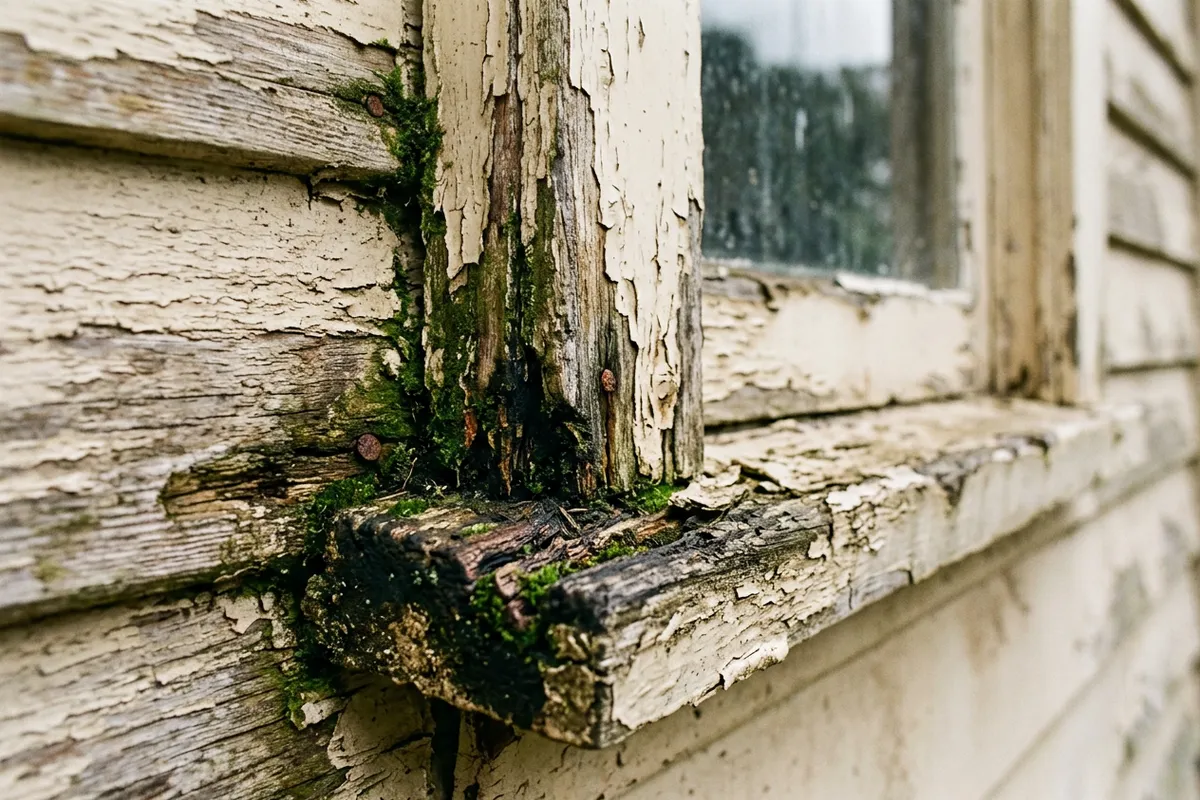
A rotten window frame can often be repaired if enough sound timber is left. A carpenter cuts out the decayed section and splices in matching timber, or treats localised damage with epoxy, then fixes the reason the timber stayed wet. If the decay has gone too far, the sill or the whole frame is replaced. Either way, the water source has to be dealt with first, or the repair rots again.
This guide covers how to check a frame without causing damage, what the repair options are, what to screen for in an older house before anyone scrapes or sands, and when replacement is the better decision. For doors, see door frame rot repair. For replacing the window, see timber window replacement.
Fix the water first
Water getting into the frame is what makes timber rot. The Forest and Wood Products Australia window guide, published through WoodSolutions, says water build-up damages timber, finishes and joints, and that flashings at the head, sill and jambs and a correct drainage angle on the sill are what keep water out of the opening. A patch on the surface does not make up for water getting in behind the frame.
| Possible cause | What it means for the repair | What to do |
|---|---|---|
| Missing or poor flashing | Water gets past the visible surface to hidden parts of the opening | Have the carpenter check the opening and flashing, not only the soft spot |
| Cracked paint and exposed end grain | Moisture enters the timber, and movement keeps cracking the coating | Repair sound timber, then restore the paint system and seal end grain |
| Poor sill drainage or weak joints | Water sits and damages the finish, the timber and the joints | Restore the drainage angle and the joint detail |
| Condensation | Warm moist air on a cold surface wets the finish and encourages mould | Deal with indoor humidity and ventilation, since not every wet sill is a rain leak |
| Termites | Galleries, mud tubes or hollow-sounding timber are a different problem from rot | Stop disturbing it and arrange a pest inspection. See termite damage repair |
Dulux's maintenance manual describes how the cycle runs: timber cracks, moisture enters where repainting is put off, and trapped moisture leads to blistering, mould, more movement and eventually rot and widespread peeling. Repainting the visible blister leaves the cause in place.
Check the frame without making it worse
Rot often shows as darkened timber or peeling paint over soft, crumbly wood. A dark stain alone does not prove decay, because discolouration can be on the surface with sound timber underneath. Soft, spongy timber, or timber a screwdriver goes into easily, is the warning sign in Timber Queensland's assessment guidance.
Read the next section before you do this check. If the house was built or renovated before 1990 or the paint is older than 1970, do not scrape, sand or probe through old paint first. The check below is for exposed timber only.
- Look first. Photograph the sill, its corners and where it meets the vertical frame, and note where paint has failed and where water seems to collect.
- With light hand pressure and no hammering or levering, press a small flat screwdriver against exposed suspect timber, then against sound-looking timber nearby.
- If it gives easily, stop. Do not dig to find out how far it goes.
- Give the photographs to the carpenter. A firm surface does not show the condition of the joints or timber you cannot see.
This is a screening check, not a structural test. The guidance gives no penetration depth that certifies a frame as safe.
Older houses: asbestos and lead paint
Do this screening before any scraping, sanding or cutting. SafeWork NSW says any house or building built or renovated before 1990 could contain asbestos. Taking out a window can disturb more than timber, since the surrounding sheets, eaves or fibro cladding may be involved. If you suspect asbestos, stop work and get help, and do not drill, sand, cut or sample suspect material.
Dulux's technical advice says most Australian homes built before 1970 were coated with lead-containing paint. Its advice is to test old paint before preparing it, never to dry sand or dry scrape, and not to use heat guns or open-flame burners. Wet sanding or chemical stripping with proper precautions are the accepted methods, and a trained professional is recommended where lead is found. Keep children and pregnant or nursing people away while lead paint is disturbed.
Repair options
| Option | A reasonable choice when | Move on from it when |
|---|---|---|
| Epoxy consolidant and filler | The damage is localised, the assessment shows enough sound timber remains, the timber can be dried and the water source is fixed | The remaining strength or the hidden condition is uncertain |
| Splice or replace a section | The decay can be cut back and matching timber joined to sound timber | Opening up shows decay past the joint or fixing area |
| Replace the sill or one member | The part is too far gone for a patch but the rest of the window can stay | The neighbouring members and joints cannot give a reliable assembly |
| Replace the frame or window | The decay is too extensive, or an assessment cannot establish a sound repair | Do not replace the whole window only because one small area is soft |
No source gives a percentage of rot that decides between these, so the call is made on the actual window. A small defect at a critical joint deserves more caution than its size suggests.
Norglass's guide to repairing rotted window sills starts with an assessment of the decay. Its epoxy treatment is for timber that keeps some structural integrity, and replacement is the sensible choice when decay has gone too far. Forest and Wood Products Australia separately recommends cutting back decayed timber and patching with compatible timber. Queensland's guidance on minor timber repairs calls for patches that match the species, grain direction and profile.
Epoxy has limits that product data sheets spell out:
- The surface must be clean, dry, oil-free and dust-free for the filler to bond. WEST SYSTEM's instructions say epoxy cannot displace water in the wood, and that on damp timber adhesion is reduced and deterioration may continue.
- Epoxy has poor UV resistance, so Norglass's treatment cannot stay exposed to direct sunlight and needs a protective coating.
- Do not mix unrelated products. Norglass warns that polyester fillers over its treatment fail to cure.
- A hard finished patch does not prove the cause of the wetting is fixed.
Ask for a written scope that names the treatment, the filler, the primer and topcoat, and the surface preparation. After the repair, keep the paint maintained. Dulux recommends inspecting the finish at least every 12 months and Forest and Wood Products Australia recommends recoating before bare timber is exposed.
What a repair costs
We do not publish a repair price, because it depends on how much timber is affected, whether the window stays in place and what is behind the frame. The bill is shaped by how many members are involved, whether joints are affected, the access, the glass and the paint system. The timber window replacement guide has the figures we use for replacing and repairing windows, and rotten weatherboards: repair or replace covers the same decision for the cladding around a window.
NSW licensing and insurance
In NSW you need a contractor licence for residential carpentry valued at more than $5,000 in labour and materials including GST, and the carpentry category includes windows and doors. Check the licence on the NSW Public Register. Home Building Compensation insurance generally applies to residential work over $20,000 including GST, unless exempt, and should be in place before work starts or any deposit is paid. Our guide to finding a reliable tradesperson covers the questions to ask. Those are legal thresholds, not price estimates, and a job under either amount can still be unsuitable for DIY if it involves old paint, asbestos or structure.
Get a rotten window assessed
Tell us which windows, roughly how old the house is, and where the water seems to be getting in. We will say whether the frame can be repaired, whether the sill or the window needs replacing, and what has to be dealt with first. Call Dave on 0414 007 351, read about our door and window work, or use the contact page.
Sources
- Timber windows and doors, Technical Design Guide 10, Forest and Wood Products Australia (WoodSolutions)
- Guide to the assessment and repair of flood-damaged timber, Timber Queensland
- Minor repairs to timber doors, Queensland Government
- Repairing rotted timber window sills, NORSEAL data sheet, Norglass; WEST SYSTEM wood rot repair instructions
- Dulux construction solutions maintenance manual and lead in paint technical advice, Dulux
- Asbestos, SafeWork NSW
- Carpentry work licences, NSW Government
Common questions
Can a rotted window frame be repaired?
Often yes, when sound timber remains. A carpenter cuts back the decayed section and splices in compatible new timber, or, for localised damage with enough structure left, uses an epoxy consolidant and filler. If the decay has gone too far, replacing the sill or the frame is the right repair. A carpenter needs to see it to say which.
How do you fix rotting wood without replacing it?
Fix the water source first, then dry the timber. Where enough sound timber remains, the damaged part is cut out and patched with matching timber, or treated with an epoxy consolidant and filled, then primed and painted. Epoxy products are made for timber that still has some structural integrity, so they are not a way to rebuild a frame that has gone.
How much does it cost to repair a rotted window frame?
It depends on how much timber is affected, whether the window can stay in place, and what is behind the frame. We do not quote from a photo. Our timber window replacement guide covers the replacement side, and a repair is priced after a carpenter has looked at it.
What are some temporary fixes for a rotted window sill?
The honest short-term step is to stop water getting in: keep the sill painted and sealed where the timber is still sound, and clear anything that holds water against it. A filler over wet or soft timber will not last, and an epoxy repair on wet timber bonds poorly. Book an assessment rather than relying on a patch.
Can you stop wood rot once it starts?
You can stop it spreading by removing the water source and cutting out or treating the decayed timber. Rot needs prolonged moisture, so if the wetting continues it will carry on. The decayed section does not recover. It is cut out, consolidated or replaced.
Is it cheaper to repair or replace a window?
A local repair is often less work than replacing the whole window, but not always. If the decay is in a joint or in several members, the repair can approach the cost of replacement and may not last. The assessment decides it, and our window replacement guide covers the replacement side.
Is window wood rot covered by insurance?
We cannot say for your policy. Read the wording and ask your insurer before any work starts, and do not assume rot from long-term moisture is covered.
Want a hand with this at your place? Get a free quote or call 0414 007 351.