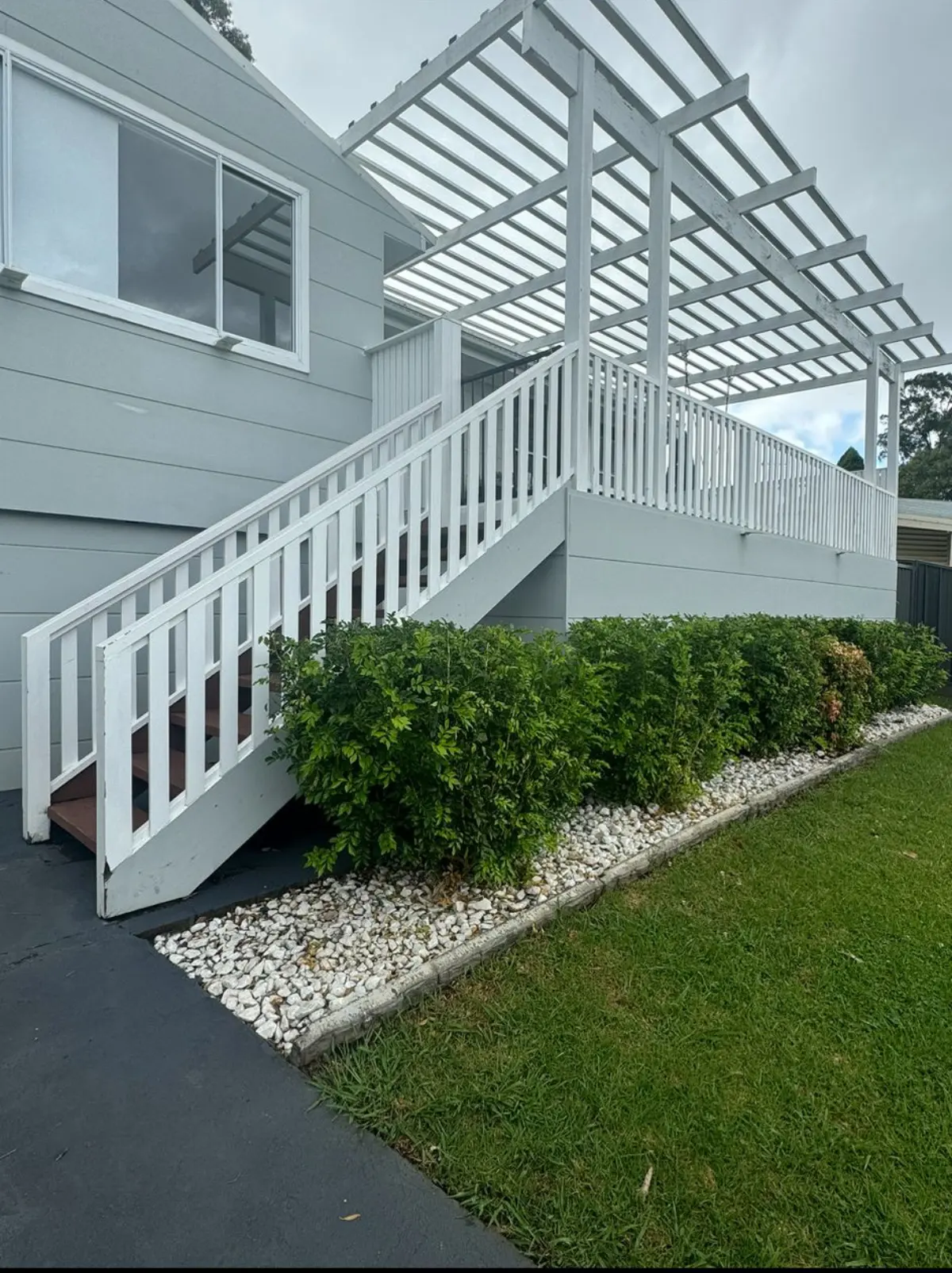
Every second deck quote we do around the Gong starts with the same question. Hardwood or composite? And people usually want me to just tell them which one's better.
I won't, because there isn't one. There's the deck that suits your budget and how much weekend maintenance you're actually willing to do. For most people those are two different things, so let's go through it properly.
Hardwood — merbau and spotted gum
This is still what most Illawarra decks are built from, and for good reason. Merbau (you'll see it called kwila too) has that deep reddish-brown colour, it's hard as nails, and it copes with our weather. Spotted gum is the local hardwood — greyer-brown, gorgeous grain, a bit pricier and a bit harder to work. But it's a properly Australian timber and it lasts.
On materials alone, merbau decking boards run somewhere around $9 to $14 a lineal metre depending on width and where you buy. Spotted gum sits a touch above that. So hardwood's usually the cheaper start.
Here's the catch, and it's a real one. Hardwood needs oiling. Not once — forever. A new merbau deck wants a coat in the first few months, then realistically once a year, sometimes twice if it cops full afternoon sun or sits near the pool. Skip it and the timber doesn't fall apart, but it greys off. That silver-grey weathered look. Some people love it and let it go on purpose, which is totally fine. Just know that's the deal you're signing up for.
The other thing nobody mentions at Bunnings: hardwood moves. It checks, it cups a little, and after a few years the surface can throw the odd splinter, especially around the nosing and the board ends. A sand and re-oil sorts it. With bare feet and kids running about, you'll want to stay on top of that. None of it's a dealbreaker — it's just the nature of a real timber deck.
Salt air doesn't bother the timber much. What it bothers is the fixings. If you're anywhere near the coast — and round here that's most of us, from Thirroul to Shellharbour to down past Kiama — you want stainless steel screws, not the cheap galvanised ones. Galv rusts out near salt and you get black bleed stains weeping down every board. Cheap fixings on a good deck is the most common mistake I get called out to fix.
Merbau or spotted gum?
Spotted gum if you want an Australian hardwood and you'll wear a bit more for it. Merbau if the starting budget is what's deciding it. Both build a deck that lasts down here, so it's a look-and-cost call rather than a durability one.
The differences that actually show up are small. Spotted gum sits a touch above merbau on materials, as above, and it's harder to work, which lands on a quote as labour rather than boards. Merbau is the one that bleeds tannin through its first year, so alongside pale pavers or a light pool surround the spotted gum saves you some hosing. On colour, merbau is the deep reddish-brown and spotted gum the greyer brown with more grain showing, and both will silver off the same way if you stop oiling them.
Jarrah, kapur and the other hardwoods people ask about
Merbau and spotted gum are what most Illawarra decks get built from, but two other names turn up on quotes often enough to be worth covering.
Jarrah is the West Australian hardwood. Deep red-brown, very durable, and it holds colour better than most boards do. The catch on this side of the country is supply — it has to come across, so it generally costs more here than merbau and you won't always get the lengths you want off the shelf. If you're set on that dark red and you're not in a rush, it's a lovely deck.
Kapur is the one sold as a merbau substitute, because it looks similar and often prices a touch under. It's a fair board. It's just a bit less stable than merbau, so expect more checking and movement over the years, and like merbau it bleeds tannin in the first year. Keep it off pale pavers or seal it early, or you'll be hosing rust-coloured run-off off the concrete every time it rains.
Upkeep is the same story on all of them. Oil in the first few months, then about once a year, or let it grey off on purpose. There's more on picking a board in choosing decking timber.
Composite — never touch it again
Composite is a wood-fibre and plastic mix made up into boards. The big sell's dead simple: no oiling, ever. You hose it, give it the occasional scrub, and that's your lot. No greying, no annual ritual, no splinters. For a lot of busy households that alone wins it.
It's not cheap to buy in, mind you. Good composite boards land around $90 to $160 a square metre just for the deck surface, where hardwood might be half that on materials. Labour's much the same either way, so the gap really sits in the boards. You're paying upfront to save yourself years of oiling. Whether that maths works depends on how long you're staying and how much you value your Saturdays.
A couple of honest downsides. The first is heat. Dark composite in full Illawarra summer sun gets hot underfoot — properly hot, the kind where the kids hop across to the pool. Lighter colours and a bit of shade help a lot, so have a think about your aspect before you lock in a colour.
The second is the look. The good stuff genuinely looks the part these days. The cheap stuff still reads a bit plasticky and uniform up close, so you get what you pay for.
Ekodeck, ModWood, Trex — does the brand change the answer?
Not the trade-off, no. They're all composite, so the no-oiling upside and the hot-underfoot downside apply across the lot. What changes brand to brand is the colour range, whether the board is capped with a hard outer skin, how well it hides scratches, and how long the warranty runs. Capped boards generally hold colour and shrug off marks better, and you pay for that. Pick the look you want, then read what the warranty actually covers — fade and staining, or only the board falling apart.
Where composite really earns its keep is pool surrounds. No oil washing into the water, no splinters near bare feet, and no constant re-coating in the one spot that cops the most sun and the most traffic. Around a pool I'll often steer people toward composite even if they've gone hardwood everywhere else. Timber or composite is only part of a pool deck's price; what a pool deck costs covers the barrier and certifier add-ons that sit on top of the board cost.
Working out how much merbau you need
Take your deck area and divide it by the cover width of the board, then add ten per cent for waste and cuts. A standard 90mm merbau board covers about 86mm once it's laid, so the rule of thumb is roughly 11.6 lineal metres of board per square metre of deck.
So a 20 square metre deck is about 230 lineal metres of merbau with the offcuts allowed for. At $9 to $14 a lineal metre that's somewhere around $2,100 to $3,200 in boards. That's the walking surface only. Bearers, joists, posts, stainless fixings, stumps or footings and the labour all sit on top, and on most jobs the frame under the deck costs more than the deck does.
If it's an odd shape, or it's stepping down a slope like half the blocks around here, don't bother with the sums. We'll take the levels off the site and cost it properly.
How much is merbau decking per square metre?
Merbau is sold by the lineal metre rather than the square metre, so a per-square-metre price is a conversion rather than a number you'll see on the rack. Take the $9 to $14 a lineal metre above and multiply it by the 11.6 lineal metres it takes to cover a square metre, and that's your board cost for one square metre of deck.
Two things to know before you lean on that figure. It's the walking surface only, and on most decks the frame underneath comes to more than the boards do, so it isn't a deck price. Board width moves it as well, because a wider board covers the same square metre in fewer lineal metres — the 11.6 comes off a standard 90mm board covering about 86mm once it's laid. Labour, stainless fixings and footings all sit on top.
So which one's for you
Quick gut-check:
- Hardwood if you want a real-timber look, you've got a tighter budget to start, and you genuinely don't mind oiling once a year (or you're happy to let it grey off).
- Composite if you'd rather never touch it again, you've got a pool, or you just want your weekends back — and the higher upfront cost sits alright with you.
It's a budget-and-upkeep call, not a quality one. Either one builds into a deck that'll outlast plenty around here, provided it's framed properly, flashed right against the house, and screwed off with the correct fixings. Honestly, that last bit matters more than the board you pick. I've pulled up beautiful merbau decks rotted out underneath because the bearers weren't done right.
If you're weighing it up for your own place, give us a call and talk it through. Dave can come out, look at your block, your aspect and how you actually use the yard, and give you a straight answer either way — plus a free quote with both options costed so you can see the real difference. We're local and fully licensed, covering Helensburgh down to Nowra.
If you're re-boarding rather than starting fresh, deck repairs is the page for that. Ring 0414 007 351 whenever suits. No pressure, happy to just give you a steer.
Common questions
- How much does merbau decking cost?
- Merbau decking boards run somewhere around $9 to $14 a lineal metre depending on width and where you buy. That is the walking surface only — bearers, joists, posts, stainless fixings, footings and labour all sit on top, and on most jobs the frame under the deck costs more than the deck does.
- How do you work out how much merbau decking you need?
- Take your deck area, divide it by the cover width of the board, then add ten per cent for waste and cuts. A standard 90mm merbau board covers about 86mm once it is laid, so the rule of thumb is roughly 11.6 lineal metres of board per square metre of deck. A 20 square metre deck is about 230 lineal metres with the offcuts allowed for. If the deck is an odd shape or stepping down a slope, skip the sums and get the levels taken off the site.
- Why has my merbau deck gone grey?
- It greys off when the oil gets skipped. That silver-grey weathered look is neglect, not rot, and plenty of people let it happen on purpose. A clean, a sand and a couple of coats of decking oil bring merbau and spotted gum right back. What does need attention is anything soft and punky underneath, because that is rot rather than weathering.
- Is merbau or treated pine better for a deck?
- Merbau is the denser board and the better look, and it is the cheapest of the proper hardwoods. Treated pine is the budget play — soft enough to mark if you drop a planter on it, but cheap and quick to lay. Pine also wants paint or a solid stain rather than oil, and you need H3 for above-ground boards and H4 for anything in or near the dirt. Mix those grades up and the timber rots from the ground up while the top still looks fine.
- Is composite decking better than merbau around a pool?
- Around a pool, usually yes. There is no oil washing into the water, no splinters near bare wet feet and no re-coating the one spot that cops the most sun and traffic. The trade-off is price and heat — good composite lands around $90 to $160 a square metre for the surface alone, and dark colours get properly hot underfoot in an Illawarra summer. If you are set on timber by the pool, spotted gum holds up better than merbau.
Want a hand with this at your place? Get a free quote or call 0414 007 351.