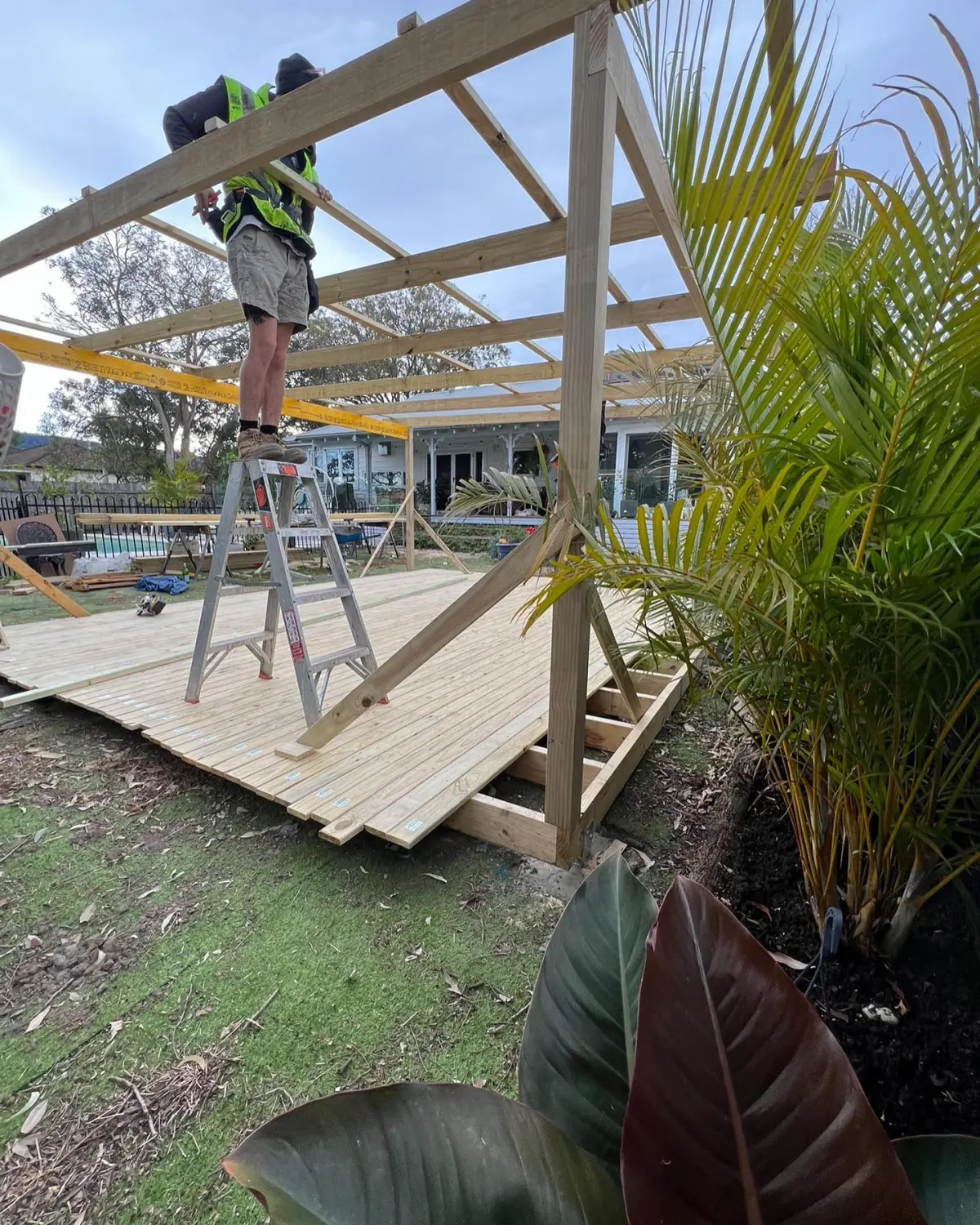
Putting on an extension, a granny flat out the back, a new garage, or just splitting a big room in two? The frame is the bit that decides whether the whole lot stays straight for the next thirty years. Get it square and plumb from the off and everything after — plasterboard, doors, windows, cladding — goes on easy. Get it wrong and you'll be chasing dramas the whole way through.
That's the part I take seriously.
I'm Dave. I run All Round Carpentry, and I've stood frames on the lot — tidy new estate blocks down Shellharbour way, post-war fibro places in the older Gong suburbs where not a single wall's actually straight.
Set out square, plumb and to code
A frame's only as good as its set-out. I work off the slab or bearer line, snap my plates, check the diagonals and make sure the whole thing's square before a single stud goes up. On a level new slab that's quick. On a sloping block or an old timber floor that's sagged a bit over the decades it takes more care — packing, scribing, sometimes a new bearer and joist before the wall even starts.
Timber-wise it's mostly MGP10 pine for standard stud walls, stepping up to MGP12 or LVL where you've got bigger spans or point loads coming down. Treated pine where there's any chance of moisture — bottom plates on slabs, anything near a wet area or an external wall. Out here near the coast the salt air's no joke, so I won't cut corners on treatment grades or fixings. Stainless or hot-dip galv where it counts, not bright steel that'll weep rust through your render in a couple of winters.
Everything's fixed to the current NCC and AS 1684 framing code — stud spacings, tie-downs, bracing, the lot. The southerly busters that come through here put real wind load on a structure, so the bracing and hold-downs aren't a box-ticking exercise. They're what keeps your roof on.
Load-bearing walls and when an engineer's needed
This is where you want a chippy who'll be honest with you. A non-load-bearing wall — say you're closing off a study inside an existing room — is a fairly simple job and usually doesn't need approval. A load-bearing wall, or taking one out, is a different animal.
The moment a wall's carrying roof load, or floor load above, or you're opening it up to drop a beam in, you're into engineering. That means:
- A structural engineer sizing the beam or lintel and signing off the design
- Council approval — either a CDC through a private certifier or a full DA, depending on your block and the work
- An inspection at frame stage, before it gets covered up
I won't tell you that you don't need an engineer just to win the job. If your plans call for one, you need one, and I'll work to their drawings. For extensions, granny flats and garages across Wollongong, Shellharbour, Kiama and down the Shoalhaven I've dealt with the local councils and certifiers plenty of times, so I can steer you right early instead of you finding out halfway through.
Sub-frames, outbuildings and the awkward stuff
Not every job's a full house frame. A fair bit of what I do is the in-between work — a sub-frame to carry a new bathroom floor, framing out a garage to turn it into a rumpus, the structure for a carport or a lean-to, or sorting the bones of a shed going up on an uneven pad.
Older Illawarra homes throw up surprises the second you open a wall. Termite damage in an old bottom plate. A previous owner's dodgy reno. Brickwork that's bowed. I'd rather find that early and fix it properly than frame straight over the top of a problem.
Fully licensed and insured, and you deal with me the whole way — no being handed off to some subbie you've never met.
Got plans? Or even a rough idea sketched on the back of something? Give me a call on 0414 007 351 or send it through for a free quote. Happy to come have a look, talk through what's load-bearing and what's not, and give you an honest price.
Common questions
- Do I need an engineer or council approval for my wall frames?
- Depends on the job. Anything load-bearing, or a new room or granny flat, usually needs engineered plans and either a CDC or DA through council. A simple non-load-bearing stud wall inside an existing room often doesn't. I'll tell you straight which camp you're in before we start.
- Do you build the frames on site or use prefab?
- Both, and it comes down to the job. Standard estate walls suit prefab frames delivered and stood in a day. Renos in older Wollongong homes with out-of-square brick or sloping floors I usually stick-build on site so everything actually lines up.
- How much does wall framing cost?
- A single internal stud wall might run a few hundred to a thousand-odd dollars supplied and fixed. A full granny flat or garage frame is many thousands and depends on size, span and whether engineering's involved. Give me the plans or a rough idea and I'll quote it properly — no charge for the quote.