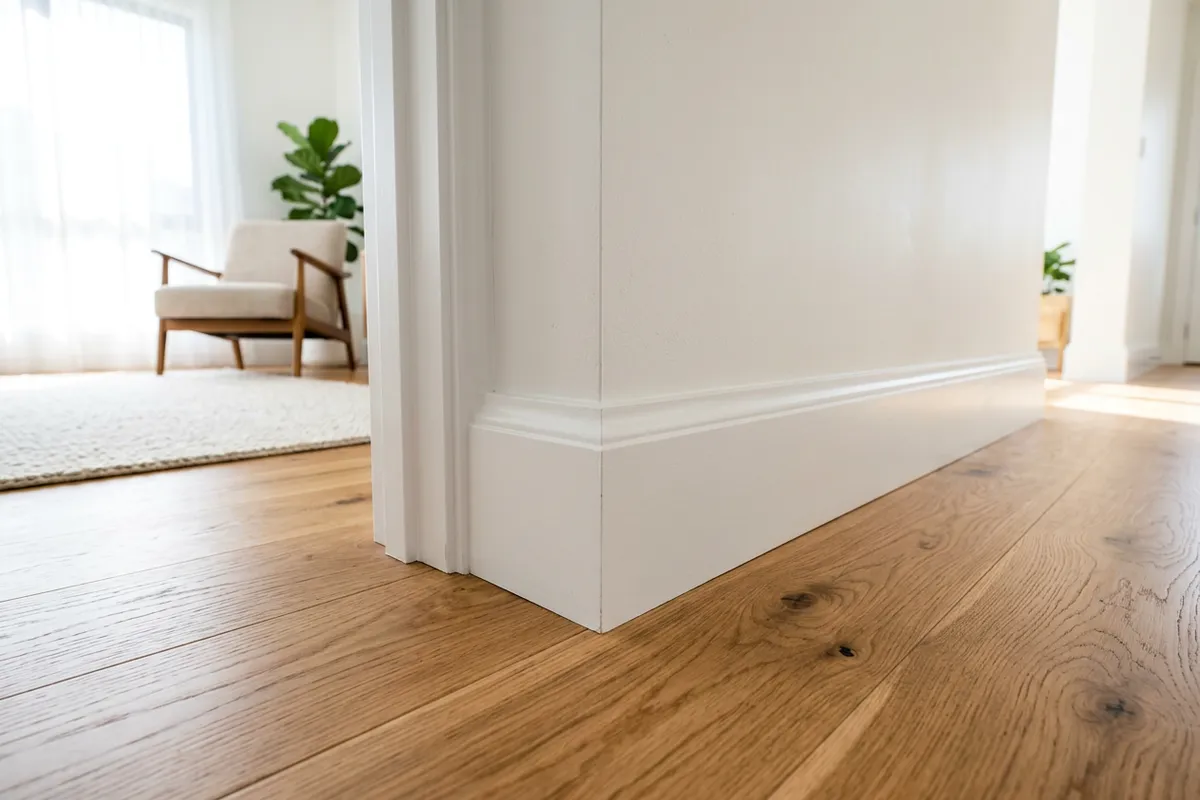
Skirting boards are worth replacing when MDF has swollen, timber has gone hollow or soft, or joints keep opening. Those symptoms point to moisture, movement or termites, so the cause comes before the new board. Choose the material for the room's exposure, keep floating floors free of the trim, let boards acclimatise before fitting, and compare quotes on the whole scope and not just the board.
Repair or replace
| What you see | What it can mean | What to do |
|---|---|---|
| Swollen or bubbling MDF | Repeated wetting from mopping or steam cleaning, a nearby leak, or a damp wall or floor interface | Find the source. A plumber if a leak is suspected, then a carpenter once it is fixed |
| Open joints or cracked paint at joins | Boards that were not acclimatised, changes in temperature and humidity, or weak fixing | Photograph and date the gap and note whether it changes with the seasons. A local repair is usually enough unless the movement is progressing |
| Chipped edges, loose fixings | Impact, split ends, or unsuitable fixing | Repairable on sound boards. Do not add nails into a wall of unknown services |
| Peeling paint or staining through a new finish | Dirt, grease or loose coating left under the paint, damp, or tannin bleed from some timbers | Check for damp, then repaint with the right prep. Do not sand old paint until the lead and asbestos question is settled |
| Hollow, wafer-thin or mud-marked timber | Possible termite activity | Stop disturbing it, do not spray, and have a pest inspector look before any carpentry |
Termite signs are covered in termite damage repair. Damp from under the house is covered in subfloor ventilation and damp. Replacing the board without finding the cause fixes the look and not the problem. If you are sanding or cutting old painted skirting in an older house, read the NSW Government's page on dealing with hazardous materials first.
Choosing the material
The choice is about exposure and finish. Intrim lists MDF, finger-jointed pine and hardwood as the main options, and its preference for pine is a supplier's view and not an independent test.
| Material | Strengths | Limits | Suits |
|---|---|---|---|
| MDF | Smooth, flat surface for painting; can cost less than timber | Edges chip and split; swells with moisture; made for painting, not staining | Painted trim in dry interiors, where the specific product is approved for it |
| Finger-jointed pine | Real pine; light to handle; holds nails well; marks can be sanded and repaired | Soft enough to dent; not the same as clear, stain-grade timber | Painted trim where repairability matters |
| Hardwood | Natural grain for clear or stained finishes; species include Victorian ash, Tasmanian oak and spotted gum | Shorter lengths mean more joins and longer installation | Visible timber as part of the design |
Porta limits its pre-primed MDF to dry interiors and excludes bathrooms and external use, and it requires cut ends to be sealed with primer or PVA. Intrim warns about dampness, mopping and steam cleaning. Water can get in at vulnerable edges even when the face looks well painted, so repeated wetting needs fixing and a different paint will not solve it.
Match the profile before ordering. Keep a short undamaged piece of the old board as a sample, and record its height, thickness and shape and how it meets the door architraves. Intrim's examples pair 135 mm skirting with 2400 to 2500 mm ceilings and 185 mm with 2501 to 2700 mm ceilings, which is a design suggestion and not a building rule. Shadowline skirting is a different system, normally fixed to the wall framing before the plasterboard goes up, so it suits jobs where the wall lining is already being replaced.
Removing the old boards
Intrim's method starts with the paint line. Cut the paint or caulk bond along the top of the board with a utility knife, because skipping this can tear the plasterboard paper above the old board and turn a trim job into a wall repair. Ease a chisel behind the board, work along its length, and lever beside the fixings with a timber wedge behind the bar. Do not use the floor edge as a fulcrum, and if the board is trapped under carpet or tiles, stop and have it assessed. Pull exposed nails and make the wall sound before the new board goes on.
Floating floors
For a floating floor, the skirting is fixed to the wall and not to the flooring. Allowances differ by product, so board height does not decide the gap:
| Flooring (Quick-Step manuals) | Perimeter gap stated |
|---|---|
| Laminate | 8 to 10 mm standard; 10 to 12 mm in smaller, cooler or lower-humidity conditions; 14 to 16 mm in specified higher-humidity regions |
| Engineered timber | 10 mm minimum; larger areas or higher humidity can need more, up to 15 mm in coastal examples |
| Ciro hybrid herringbone | 8 mm around the perimeter, pipes, thresholds and under door frames |
Check that the skirting covers the gap your floor needs without pinning the floor down. Quick-Step links restricted movement to bubbling, open joints and separating planks. Do not fill the gap with ordinary silicone. The manuals specify a foam strip and a flexible sealant for water-resistant finishing, so follow the system for your floor.
Fitting and finishing
- Prepare the wall. Remove old nails, loose paint and flaking plaster, fill major imperfections, and mark stud positions.
- Condition the boards. Porta says to store MDF flat, undercover, on supports no more than 600 mm apart, and to unwrap it in the room 48 hours before installation.
- Plan the lengths. Plan joins wall by wall and allow at least 15% for wastage, as Intrim's manual does.
- Form the corners. Intrim's traditional method starts with a square-ended piece, scribes the next board to the profile at internal corners, and mitres external corners. Longer walls take a glued scarf joint over a stud.
- Fix to framing or masonry. Nails through the board and lining into studs, or the specified adhesive method. Masonry needs plugs, screws and adhesive, and concealed services should be checked before drilling.
- Fill, sand and paint. Suppliers disagree on pre-primed MDF: Porta calls its board ready to paint after filling and light sanding, while Intrim says its factory primer is a transit coat and needs a site primer. Dulux says tannin-rich timbers may need an oil-based primer. Agree the board and the paint system before comparing painting quotes.
What a quote should cover
Ask for the board type and profile, the lengths supplied including wastage, removal, wall repairs, fixing method, the detail at the floor, and the filling and painting. Comparing a material rate against a full-scope price is not a like-for-like comparison. If a door is also being replaced, see what it costs to hang a new internal door, and if skirting is part of a larger refit, kitchen renovation cost covers how that scope is priced.
Get skirting replaced
Tell us which rooms, what the floor is, and whether the existing boards are swollen, hollow or just dated. Call Dave on 0414 007 351 or use the contact page.
Sources
- Pine or MDF mouldings, how to remove skirting boards and the skirting and architrave installation manual, Intrim
- Guide to Porta pre-primed MDF mouldings, Porta
- Quick-Step installation manuals for laminate, engineered timber and Ciro hybrid flooring; Dulux 1 Step Prep data sheet
- Dealing with hazardous materials, NSW Government
Common questions
How much does it cost to replace skirting boards?
It depends on the board, the length, the removal and wall repairs, the fitting and the painting, and we do not quote a figure without seeing the rooms. When you compare quotes, compare what is included. Boards supplied, removal, making the wall good, fixing, filling and painting are separate items, and manufacturers advise allowing at least 15% extra length for wastage.
When should skirting be replaced and not repaired?
Replace it when MDF has swollen or bubbled, when timber is hollow or wafer-thin, or when joints keep opening. Those symptoms point to moisture, movement or pests, and the cause needs finding first. Chips and loose fixings on sound boards can usually be repaired.
What is the best material for skirting boards?
It depends on the room. MDF gives a smooth painted finish but is only suited to dry interiors and can swell if it gets wet. Finger-jointed pine is easier to repair and holds nails well. Hardwood suits clear or stained finishes. One supplier's recommendation for pine is not an independent comparison, so ask for the specification of the actual product.
Can I fit skirting boards myself?
Owners do fit it, but the steps that go wrong are removing the old boards without tearing the plasterboard, checking the wall for services before drilling, and keeping a floating floor free to move. We can do the whole job, including making good, filling and painting.
Does skirting get fixed to the floor?
No. For floating floors, including Quick-Step laminate, engineered timber and hybrid floors, the manufacturer requires the trim to be fixed to the wall and not to the flooring, so the floor can move underneath.
Do boards need to sit in the room before fitting?
For MDF, yes. Porta says to unwrap its boards 48 hours before installation and let air circulate, and links skipping this to movement, paint cracking and gaps at joints.
Want a hand with this at your place? Get a free quote or call 0414 007 351.