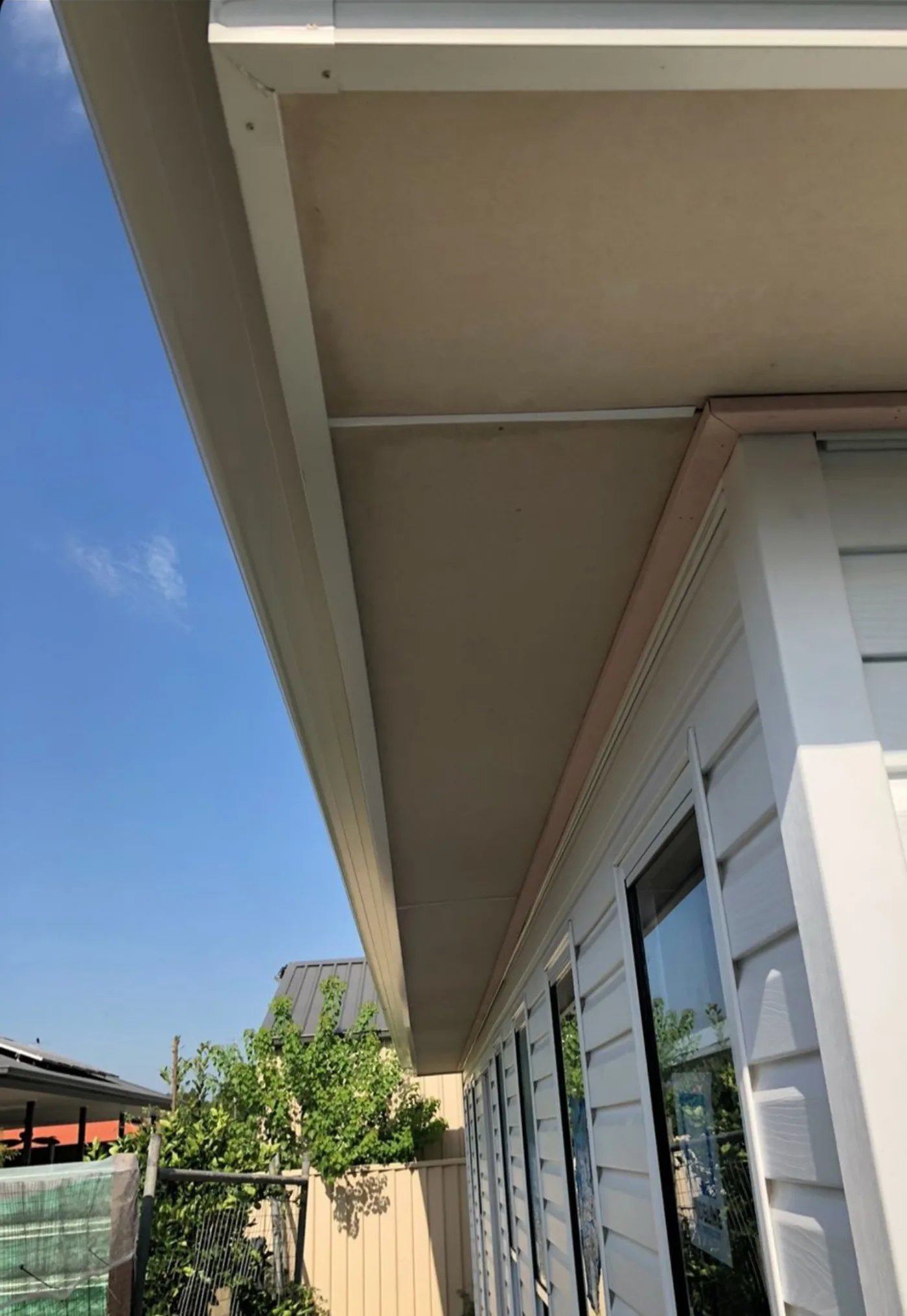
By the time you can see a brown stain on your eaves lining from the ground, the timber behind it has been wet for a couple of years.
That's the awkward part of roofline rot. It's one of the few things on a house where the damage is essentially finished by the time the symptom turns up. A gutter run packs up with gum leaves, water goes over the back lip instead of into the downpipe every time it rains, and it runs down behind the fascia and into the ends of the rafters for three winters. The soffit sheet you can actually see from the lawn is the last thing to go.
It's also why people ring the wrong trade. The stain is near the roof, so it must be roof. Most of the time the tiles are perfectly fine and what's gone is timber, which is a carpenter's go, and that split decides how the whole job gets quoted.
What does fascia, gutter and eaves replacement involve?
Replacing a fascia means the gutter comes down first, the rotten boards come off, the rafter tails behind them get checked and spliced where they've gone, new fascia goes on, and then guttering goes back up — the old one refitted, or a new one while the timber is bare. If the eaves lining has gone as well, the new soffit sheets go in at the same time, because the access is already paid for.
The sequence is fixed, and that's why nobody can give you a final number on the first visit. You can't see a rafter tail until the fascia is off it, and you can't get the fascia off without dropping the gutter.
It also spans two trades. The timber — fascia, barge boards, soffit linings, battens, rafter tails — is carpentry. The gutter, downpipes and anything above them is a roof plumber's ticket. A job quoted properly shows you both.
What does it cost to replace fascia and gutter together?
A patch job, a few lengths of fascia with the gutter taken down and put back, sits in the $800 to $2,000 range. One full side of a single-storey house with the eaves relined is more like $1,500 to $3,500, and the whole perimeter of an average single-storey home lands between $6,000 and $14,000.
Doing both at once is cheaper than doing them a year apart, because the gutter has to come off to get the fascia out either way. Taking it down and refitting it is already inside every fascia quote, including ours. The only real question is whether the old gutter goes back up or a new one goes on while the timber is bare and the access is already paid for.
New Colorbond guttering is a roof plumber's line rather than mine, and they're generally around $50 to $100 a metre for it. That comes on their invoice, not ours, so a quote covering both trades should show you the split.
The figure nobody can pin down up front is rafter tails. They turn up rotten on about half these jobs at $150 to $400 each, and you can't count them until the fascia is off, so agree a rate per tail before anyone starts.
What does it cost to install fascia, per metre?
For the Illawarra in 2026, supplied and fixed on a single-storey home with reasonable access, fascia installation runs $70 to $140 a lineal metre in treated pine or a primed composite board, which is what most jobs get.
Matching an existing hardwood fascia, spotted gum or similar on the older places, pushes that to $120 to $220 a metre because the timber costs more and it takes longer to work.
Eaves relining, meaning new fibre-cement soffit sheets on fresh battens, is roughly $90 to $190 a square metre of soffit. A typical 600mm eave over a 12 metre run is about seven square metres, so you can do that sum yourself.
Rafter tails, where the rot has tracked back past the fascia into the ends of the rafters, get cut back and spliced at about $150 to $400 each. This is the line item that turns a small job into a medium one, and you can't know how many you need until the fascia is off.
A small patch, a few lengths of fascia and a couple of soffit sheets, sits in the $800 to $2,000 range, which is the number on our roofing and eaves page and the one most people are actually after. One full side of a single-storey house, call it ten to fourteen metres with the eaves relined, is more like $1,500 to $3,500. The whole perimeter of an average single-storey home, fifty-odd metres, lands between $6,000 and $14,000 depending on the material and how much rafter damage turns up.
Two storey, or a steep block where the ladder won't sit safely, add $800 to $3,000 for scaffold or a lift. Nobody enjoys that line but it's cheaper than the alternative.
The gutter has to come off either way
Here's the part that confuses the pricing.
The gutter is screwed to the fascia. To get rotten fascia out, the gutter comes off. That's true whether the gutter is perfectly good or completely shot, so every fascia quote includes taking it down and putting it back, and that's already in the numbers above.
Which means the moment to replace guttering is while the fascia is off. The access is already paid for. New gutter on a bare fascia is a straightforward run for a roof plumber; new gutter later, on its own, means paying for the same access twice.
What I want to be clear about is who does what. We do the timber. Fascia, barge boards, soffit linings, battens, rafter tails. Guttering and downpipes are a roof plumber's ticket and so is the sheeting or the tiles above, so we work in with a plumber rather than pretending the licence covers it. On most jobs that means the gutter comes off, we replace the timber, and either the old gutter goes back up or the plumber puts new up while it's bare.
Roof plumbers around here are generally charging somewhere around $50 to $100 a metre for new Colorbond gutter, but that's their number, not mine, and you should get it from them. I've written up where the carpenter line sits versus the other trades in the carpenter or handyman post if the licensing side is what you're trying to work out.
Before you cut anything: the pre-1990 eaves lining
If the house went up before about 1990, treat the eaves lining as asbestos cement until you know otherwise. Flat sheet soffit lining is one of the most common places it turns up on Illawarra homes, and there are a lot of post-war fibro and brick places around here that still have the original.
Do not put a grinder, a saw or a drill through it. Don't get up there and rip it down on a Saturday because a quote came in high. SafeWork NSW sets out what you can and can't do yourself, and licensed removal of a small area of soffit is not the expensive part of this job. Guessing wrong is.
I'll tell you on the first look whether I think it's asbestos, and if I'm not sure we get a sample tested before anything comes down. That's a day's delay and it's worth it.
Why the rot happened, which matters more than the price
Replacing fascia without sorting the cause means you'll be doing it again in about five years.
Nine times out of ten it's the gutter. Blocked with leaves and gum nuts, so water backs up over the rear lip and runs down the timber. Sometimes it's the fall along the run, laid wrong or dropped since, so water pools at one end and sits there. Occasionally it's a valley or a flashing above dumping water into the wrong spot.
Around here there's a fourth cause worth naming: salt. Anywhere from Helensburgh down to Nowra, within a few kays of the water, the fixings holding the whole assembly together go before the timber does. Ordinary galvanised screws bleed rust streaks down a fresh fascia inside a season. We use heavily galvanised or stainless anywhere near the coast, and it costs a few dollars more per job.
So the order of work is clear the gutter line and check the fall and the flashings first, then strip the bad timber, then see how far the rot went. Not the other way around.
Repair, or replace the run
Same call as any timber repair, and the same one I go through on timber windows.
If the rot is confined to a metre or two, usually at a joint or under a downpipe, cut it out and splice in new. That's a couple of hundred dollars and half a morning. Get a screwdriver up there, or push on the fascia from a ladder near the gutter brackets. Sound timber stops the tip dead. Soft, punky timber that takes the tip is gone.
Replace the run when the rot is in more than about a third of it, when the rafter tails behind it have gone, or when the fascia is hardwood that's been painted over so many times you can't tell what's under there. Splicing a bad run in five places costs more than replacing it once and looks like it.
There's also the honest middle answer, which is that a house with one bad side and three good ones should get the one side done. Nobody needs the whole perimeter replaced because the western wall copped it. I'd rather do the bad side properly this year and look at the rest in a few years than talk you into the lot.
Getting a quote worth comparing
Ask for it in lineal metres of fascia and square metres of soffit, separately. A lump sum tells you nothing.
Ask what happens if rafter tails turn up rotten, because they will on about half these jobs, and get a rate per tail agreed before anyone starts rather than a variation later.
Ask whether the gutter is going back up or being replaced, and by whom.
And ask about painting. Fascia and soffit go up primed and sealed, not finish-painted, on most quotes including ours. It needs a painter after, or you do it yourself, and if that's not written down it's an argument waiting to happen.
Anything over $5,000 all up needs a licensed builder and a written contract under the NSW rules. A full perimeter clears that. A patch on one corner doesn't, and that sort of thing sits happily under property maintenance along with the rest of the running list.
One up at Bulli last year came in at four rafter tails, eight metres of fascia and about five square metres of eaves relined, plus a proper clear-out and a downpipe that had never been connected to anything. Two days. The stain was the cheapest part of it.
If there's a sag, a stain, or a gutter you can see daylight behind, ring Dave on 0414 007 351 or send through a photo from the ground and I'll come up and tell you honestly whether it's a splice or a side.
Want a hand with this at your place? Get a free quote or call 0414 007 351.