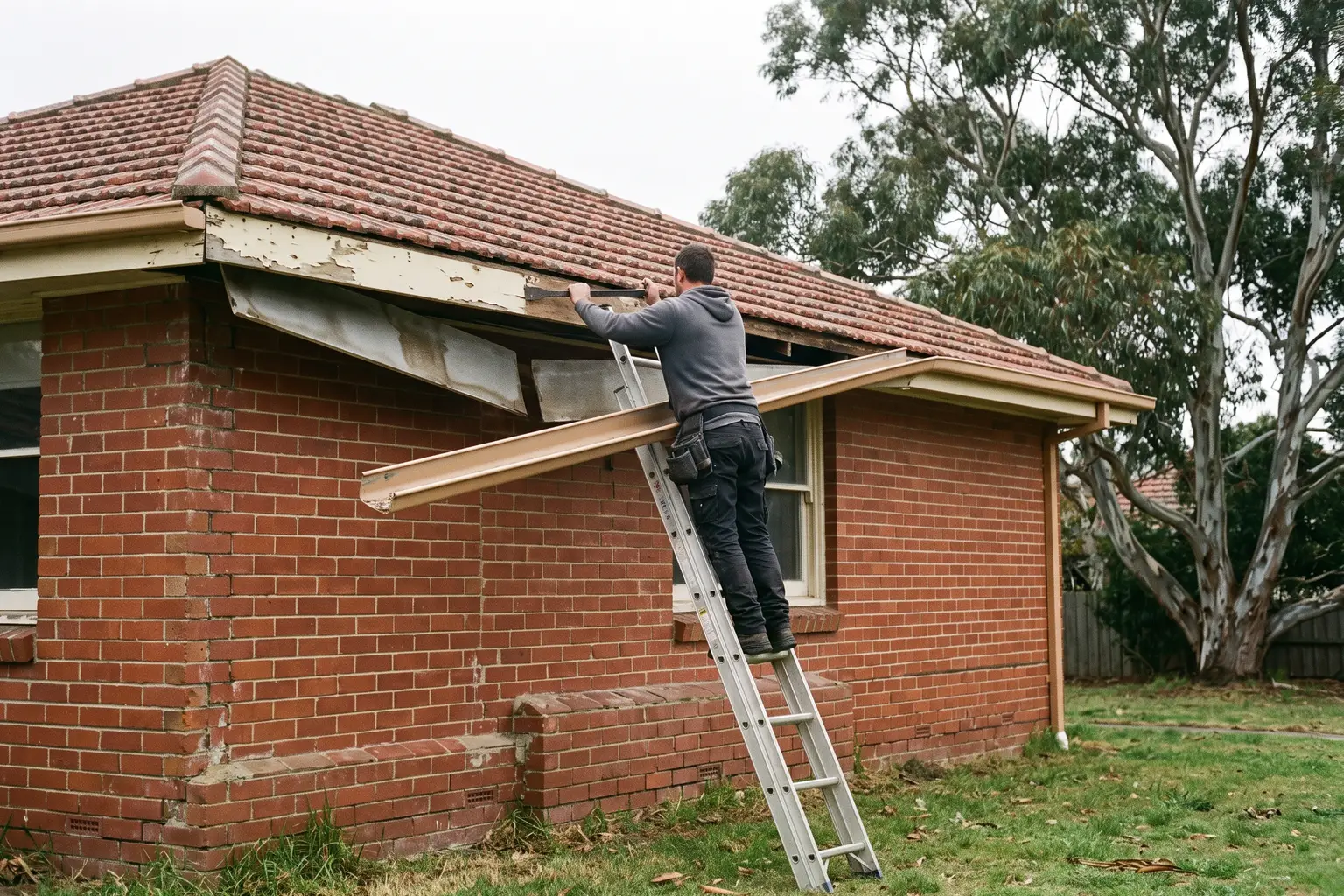
The gutter on the western side of a place at Corrimal had come away from the house by about the width of a hand. The owner had already had a bloke out to look at it. He'd pushed it back up, put three new screws through the back of it, and it was hanging again inside a month.
That's the whole problem with eaves and gutter repairs in one picture. The screws weren't the issue. They were going into fascia that had gone to sponge behind the paint, and there is no screw made that holds in timber like that. The gutter was fine. The thing it was fixed to had rotted.
So before you ring anyone, it's worth knowing which trade owns which part of the roofline, because it decides who turns up, what they can legally do, and whether the repair lasts.
Gutters and eaves repairs: which trade do you call?
The timber is a carpenter's job and the metal is a roof plumber's. Fascia, barge boards, the eaves lining and the battens behind it, and the rafter tails it all hangs off are timber work, which is us. Guttering, downpipes, flashings and the metal roof sheeting are roof plumbing.
That isn't me drawing a line where it suits. The NSW definition of roof plumbing work covers fixing, installing, repairing and maintaining guttering, downpipes, roof flashing and roof coverings, and it says in as many words that it does not cover timber and timber products. Carpentry sits on the same licence list as its own category.
In practice, what that means at your place:
- Gutter pulling away, fascia soft, eaves lining sagging or stained: start with a carpenter, because the timber is what's failed.
- Gutter rusted through, leaking at the joins, wrong fall, downpipe not connected, flashing letting water in: roof plumber.
- Both, which is common: carpenter first, plumber second, and I'll explain why below.
What a carpenter repairs
Most of what lands on the roofing and eaves page is repair rather than replacement, and it comes down to four things.
Fascia that's gone soft. Push a screwdriver into it near the gutter brackets. If it sinks, that section comes out. Where the rot is a metre or two at a joint or under a downpipe, we cut back to sound timber and splice a new length in. Where it's most of a run, the run gets replaced. The gutter has to come off either way, and that's part of the job, not a separate one.
Eaves lining that's sagging. Nine times out of ten the sheet is fine and the battens holding it up have gone, or the fixings have let go. The sheet gets dropped, new battens go in, and the sheet goes back up if it's sound or a new fibre cement sheet goes in if it isn't. On anything built before about 1990 the old flat sheet gets treated as asbestos until it's checked, and that's covered properly in the fascia and gutter replacement post.
Rafter tails. Where water has run down the back of the fascia for a few winters, the ends of the rafters behind it go too. You can't see them until the fascia is off. They get cut back and a new piece sistered on, and that's the bit that turns a small job into a medium one.
Re-hanging the gutter on new fascia. Once there's solid timber up there, the existing gutter goes back on with new brackets and it stays put. That's the fix the place at Corrimal actually needed. Three screws into rot was never going to be it.
What belongs to the roof plumber
If the gutter itself is shot, that's a new gutter, and new guttering is a roof plumber's work. Same for downpipes, the joins, the stop ends, the fall along the run, valley flashings and anything to do with the sheeting above.
The one people miss is fall. A gutter that's been up for thirty years has often dropped at one end, so water pools instead of getting to the downpipe, and sits there against the back of the fascia. No amount of new timber fixes that. It needs the gutter re-set with the right fall, and that's the plumber's call, not mine.
I'll tell you on the first look which of these you've got. If the gutter is sound and the timber isn't, you don't need the plumber. If it's the other way round, you don't need me and I'll say so.
The order matters more than people think
When it's both, the carpenter goes first. The gutter has to come down to get the rotten fascia out, so new gutter going up before the timber is fixed means it comes straight back down again. The sensible sequence is: gutter off, timber repaired, then either the old gutter back up or the plumber's new run onto bare, sound fascia while the access is already there.
There's a step before either of us, though, and it's the one that stops you doing this again in five years. Work out why the water went where it did. Almost always it's a blocked run, water backing up over the rear lip of the gutter and down the timber. Sometimes it's a downpipe that never went anywhere. Occasionally it's a flashing above. Clear it, check it, then fix the timber. Fixing the fascia and leaving the cause is how the same job comes round twice.
When it's a small job and when it isn't
A soft metre of fascia, a couple of dropped eaves sheets, a gutter re-hung: that's a morning or a day, and it sits happily on a property maintenance visit with the rest of the list.
A full side of the house with rafter tails gone, or the whole perimeter, is a different job with different numbers, and I've laid those out in the replacement cost post rather than repeating them here.
Either way, salt matters down here. Anywhere from Helensburgh to Nowra within a few kilometres of the water, the fixings go before the timber does, so whatever goes back up gets galvanised or stainless fixings. Cheap screws streak rust down fresh fascia inside a season.
If there's a gutter hanging off, an eave that's sagging, or a stain on the lining you can see from the lawn, ring Dave on 0414 007 351 or send a photo from the ground. I'll climb up, tell you which trade you actually need, and if it's me, fix the timber so the gutter has something to hold onto.
Want a hand with this at your place? Get a free quote or call 0414 007 351.