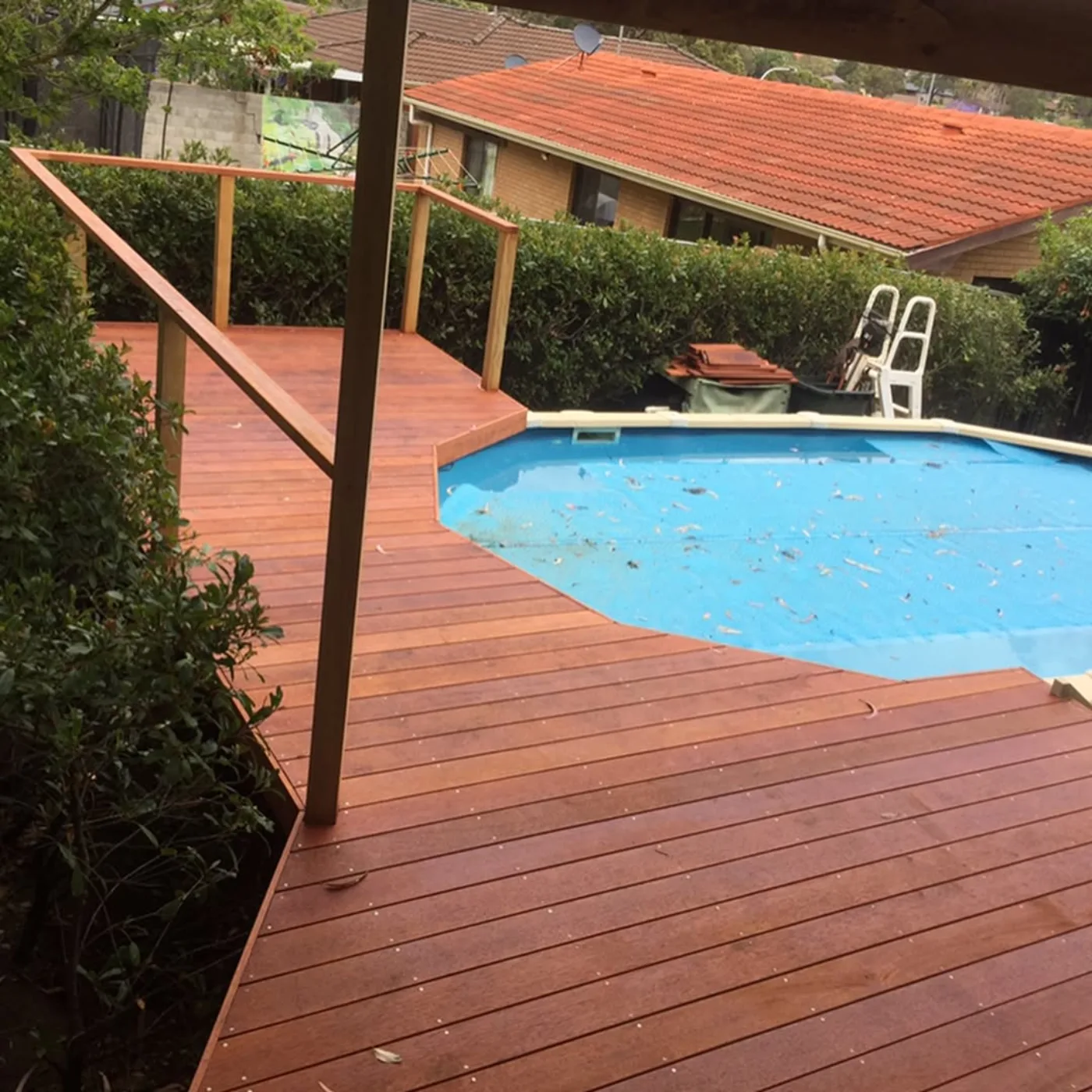
Got called out to a place at Thirroul a couple of summers back because the deck had gone sticky. Not slippery, not grey. Tacky, like the top of a bar. You'd walk across it barefoot and hear it.
The owner had oiled it three times in eighteen months, which he was rightly proud of, and each coat had gone on before the last one had properly gone off. So instead of soaking into the timber it had built up on top like a skin, and then the sun cooked it. We ended up stripping the lot back and starting again. A weekend's work he'd already done four times over.
Oiling a deck is not a hard job. It's just a job with a fair bit of waiting in it, and the waiting is the part everybody skips.
Wash it, then leave it alone for two days
Prep is most of this. If you do nothing else properly, do this bit.
Give it a sweep, then hit it with a deck wash — the oxalic acid ones you get at any paint shop or timber merchant will take grey and light mould off hardwood without much drama. Scrub it in with a stiff broom, leave it the time it says on the tin, hose it off. If there's black spotting rather than even grey, that's mould and it wants a cleaner with a bit more bite before the oil goes anywhere near it. Oiling over mould just seals it in and you'll be looking at it for two years.
Pressure washer is fine but keep the fan tip well back, half a metre or so, and keep it moving. Get close with a narrow tip and you'll fur the surface of the boards up, which looks fine wet and looks terrible once it dries and stands up like fibre. I've seen people wreck a good spotted gum deck in twenty minutes with a borrowed washer.
Then wait. Two days minimum on a dry, breezy week. Three if it's been humid or the deck's shaded, and half the decks around the escarpment side of the Gong barely see the sun in July. The timber needs to be dry all the way through the surface, not just dry to the hand. Oil on damp timber sits on top instead of soaking in, which is exactly how you get the sticky Thirroul deck.
While you're waiting, walk it. Punch any nails that have lifted, run a screw back in where one's backed out, and sand any splinters or rough patches with 80 or 100 grit. If a board flexes underfoot or you find soft, punky timber, stop — that's a repair, not a finish job, and I've written up how to tell the difference between a deck that needs restoring and one that needs replacing.
Which decking oil suits a Wollongong deck?
Either an oil-based or a water-based decking oil works on a Wollongong deck. Staying in the same family as the existing coat, applying thin coats and putting them on dry timber matter more than the brand. Oil-based products soak in deeper and take about a day to dry between coats, and water-based products dry in a few hours and are easier to recoat later. Cabot's, Feast Watson and Intergrain are all common in the area. On an exposed deck near the coast, expect to top the coat up every 6 to 12 months.
You've got two families. Oil-based decking oils soak in deeper, give you a richer colour and take longer to dry, roughly overnight between coats in decent weather. Water-based ones are lower odour, dry in a few hours, and are noticeably easier to recoat later without stripping anything back. Both work. Cabot's, Feast Watson and Intergrain are all common down here and any of them will do the job if you put them on properly.
What matters more is that you stay in the same family. Oil over an old water-based coat, or the reverse, and adhesion gets unpredictable. If you don't know what's on there, do a test patch in a corner and give it a day.
New merbau has its own trap. It's loaded with tannin, and the first few rains will bleed a red-brown stain out of it and straight onto your pavers or your rendered wall, which is a horrible thing to get off. Hose a new merbau deck down a few times over a couple of weeks and let it purge before the first coat goes on. Spotted gum's better behaved. If you're still choosing boards, I go through the options in the decking timber guide.
Buy more than you think. Two coats over a 30 square metre deck is realistically 8 to 10 litres on thirsty new hardwood, less on a deck that's been oiled before. Running out mid-deck means a visible join.
Putting it on
Lamb's wool applicator on a broom handle. Not a roller, not a brush except for cutting in around posts. A pad on a pole means you're not on your knees for four hours, which at my age matters.
Work two or three boards at a time and run each one its full length, end to end, without stopping in the middle. That's the whole technique. Stop halfway along a board and the lap mark will be visible forever, and you'll see it every single time you walk out there. Do the full run, then move across.
Thin coats. The timber takes what it takes and the rest sits on the surface and goes tacky. After about fifteen minutes have a look for any shiny puddles, especially in the gaps and up against the house, and wipe them back with a rag.
Weather rules, and this is where a Wollongong summer gets you. Don't oil in direct sun or when it's over about 30 degrees, because it skins over before it penetrates. Don't oil under about 10 degrees either. Check there's no rain coming for 24 to 48 hours, which around here is optimistic in February and pretty reliable in April. Early morning or late afternoon on a mild day is the sweet spot. Autumn is the best oiling weather we get.
Two coats, and let the first one properly dry before the second. Overnight for water-based, a full 24 hours for oil-based, longer if it's cold or shaded. Then stay off it for another day.
One thing that isn't optional: the rags. Oil-soaked rags generate heat as they cure and they can genuinely catch alight in a bin on their own, no spark required. Lay them out flat on concrete to dry, or drop them in a bucket of water before they go in the bin. Fire and Rescue NSW says the same thing every year and every year a shed goes up.
How often, really
Depends where you are, and around here that varies over a couple of kilometres.
An exposed deck at Austinmer or Bulli catching the salt and the northerly wants a top-up every 6 to 12 months. Something sheltered under a patio roof at Figtree or Albion Park will comfortably go 12 to 18 months, sometimes two years. Timber does the telling anyway: flick a bit of water on it, and if it beads you're fine, if it soaks straight in it's due.
The re-coat is nowhere near the job the first one is. Wash, dry, single coat. A morning on a normal-sized deck. It's the annual thing people mean to do and don't, and it's the difference between fifteen good years out of a hardwood deck and patching boards at seven. The Wood Solutions mob have decent technical guides on how the timber itself behaves if you want to go further down that hole.
And if your deck's composite, don't oil it. Won't absorb, won't help, and you'll spend an afternoon spreading something that then has to come off. Hose is all it wants.
Oil also won't fix rot, won't fix a wobbly balustrade, and won't stiffen up a bouncy frame. If that's what you're actually looking at, the deck repairs side of things is the real answer and the decking page covers where a rebuild sits.
Otherwise, pick a mild weekend, wash it Friday, oil it Sunday and Monday, and stay off it Tuesday. That's the whole job.
Not sure whether yours wants a coat or a chippy? Ring Dave on 0414 007 351 or send the form through and I'll come have a look. Free quote, and if all it really wants is a wash and a re-oil you can do yourself, that's what you'll get told.
Want a hand with this at your place? Get a free quote or call 0414 007 351.