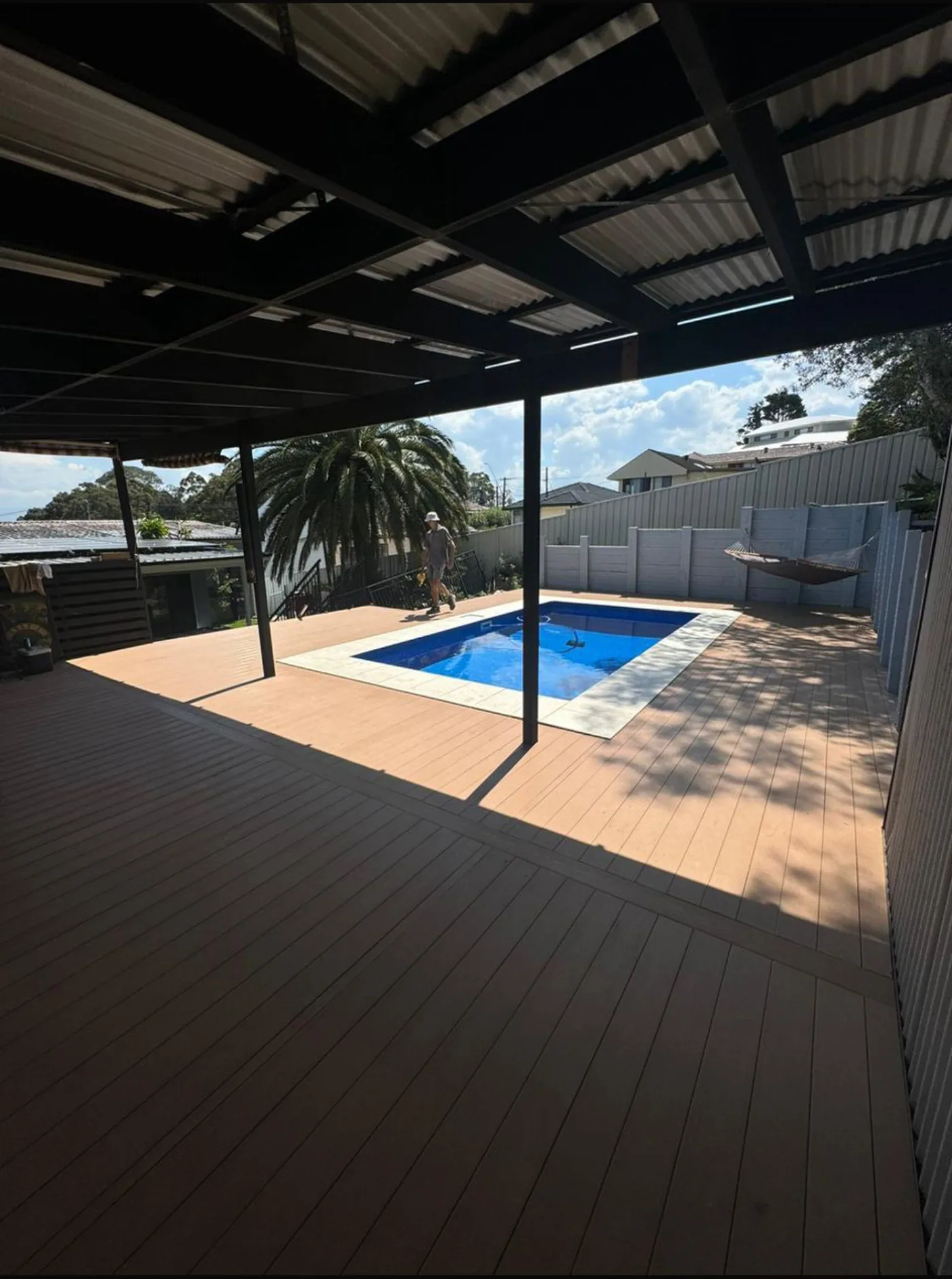
Autumn's the time to give your deck a proper once-over. Weather's cooled off, the Christmas rush hasn't started, and anything you book now gets done well before you're hosting people out the back in December. Leave it till the first hot weekend and you'll be joining a queue.
Most timber decks around the Illawarra cop a hard life. Salt off the coast, the damp that hangs about after a southerly, full western sun in summer, and the odd block down south that barely drains. A merbau or treated pine deck that went down ten or fifteen years back is usually due for some attention, even if it looks alright from the kitchen window. Here's what to actually look for.
Walk it first, then look underneath
Start with your feet. Walk the whole deck slowly and pay attention to anything that feels spongy or springy underfoot. A solid deck shouldn't move much. If a board flexes or bounces, the timber's either rotted, the joist under it has gone, or the spacing was too wide to start with. One soft board is usually just a board. A whole soft patch means the structure below is the problem, and that's the bit you can't see from up top.
While you're at it, have a look at the boards themselves. Two things to watch:
- Cupping — the board curls up at the edges so it holds water across the middle. A bit of cupping is normal on older decking. Badly cupped boards trap water, rot faster, and turn into a trip hazard.
- Splitting and cracking — long splits, especially around screw holes or board ends, let water straight into the timber. A few hairline cracks are cosmetic. Splits you can fit a coin into are not.
A handful of dodgy boards is a quick fix. We pull and swap the individual boards, match the timber as close as the weathering allows, and you're sorted in half a day. The new ones sit lighter than the old for a season until the colour catches up. That's just how merbau and spotted gum go.
The harder call is when half the boards are cupped or split. At that point you're throwing good money at a tired deck, and reboarding the whole thing onto a sound frame often works out better value than chasing it board by board.
The handrail is the one that bites
Grab your balustrade and give it a decent shove. Not a polite tap. A proper push, like someone leaning back on it at a barbie.
If it wobbles, moves, or you hear a creak from where it bolts down, that's the one to take seriously. A loose handrail is the single most dangerous fault on a deck, especially with kids about, older folks visiting, or any real drop off the edge. People put their full weight on a rail without thinking. They just assume it'll hold.
Sometimes it's a quick fix. The bolts at the base of the posts have backed off over the years, and a few new ones bring it solid again. Other times the post itself has rotted at the base, or the fixing's pulled through softened timber, and that's a rebuild of that section, not a tighten.
Worth knowing the rules side of it too. In NSW, if your deck sits more than a metre off the ground, the balustrade has to be at least a metre high with gaps no wider than 125mm so a kid can't slip through. Plenty of older Illawarra decks were built before that was enforced, or have sagged below it since. If yours predates the current standard, that's a good prompt to bring it up to spec while the tools are out.
Get under it and check the posts and bearers
This is the part most people skip, and it's where the real trouble hides. On a sloping block, plenty of decks around the Gong have a metre or more of clearance underneath, so you can usually get a torch under there and have a proper look.
You're checking the posts and bearers, especially anywhere timber meets the ground or stays damp. Press a screwdriver into the base of each post. Sound timber pushes back. If the tip sinks in like it's going into cheese, that post is rotting from the bottom up — which is exactly how it goes when a post sits in or near soil instead of on a proper stirrup. Same story for bearers sitting low to wet ground, or anywhere water sheets off the house and pools.
A bit of surface grey is just weathering and means nothing. Soft, punky, crumbling timber at a structural post is a different beast, and it's not a job to put off. We can sister a new post alongside, lift and repack onto a galvanised post stirrup to get it up off the dirt, and replace any bearer that's gone. It's more involved than swapping boards. But a single rotten post caught early is a far smaller bill than a deck that's started to lean.
Popped nails and rusty fixings
Last one's easy to spot. Run your eye along the boards for nail heads that have lifted, or fixings weeping rust stains down the timber.
Popped nails are partly just timber moving with the seasons, but every raised head is a snag for a bare foot or a thong, and a sign the fixing's lost its grip. What we like to do is pull the old nails and go back with proper decking screws — stainless if we can, or at least hot-dip galvanised given the salt air down here. Cheap fixings rust out fast near the coast, and once a fixing fails the board starts lifting and the cupping gets worse. It all feeds itself.
Rust bleeding out of the timber usually means the fixing's halfway gone already. On its own it's cosmetic and cheap to redo. Combined with soft boards and a wobbly rail, though, it's the deck telling you it's tired.
None of this needs to be a drama. A lot of what I've gone through here is an afternoon's work if you catch it early, and worst case you get a clear answer instead of wondering every time someone heavy walks across it. If you'd rather have someone who does this for a crust take a look, that's what our deck repairs work is — give Dave a call on 0414 007 351. We'll come out, climb under it, and tell you straight what it needs. Fully licensed and insured, local from Helensburgh down to Nowra, and the quote's free.
Want a hand with this at your place? Get a free quote or call 0414 007 351.