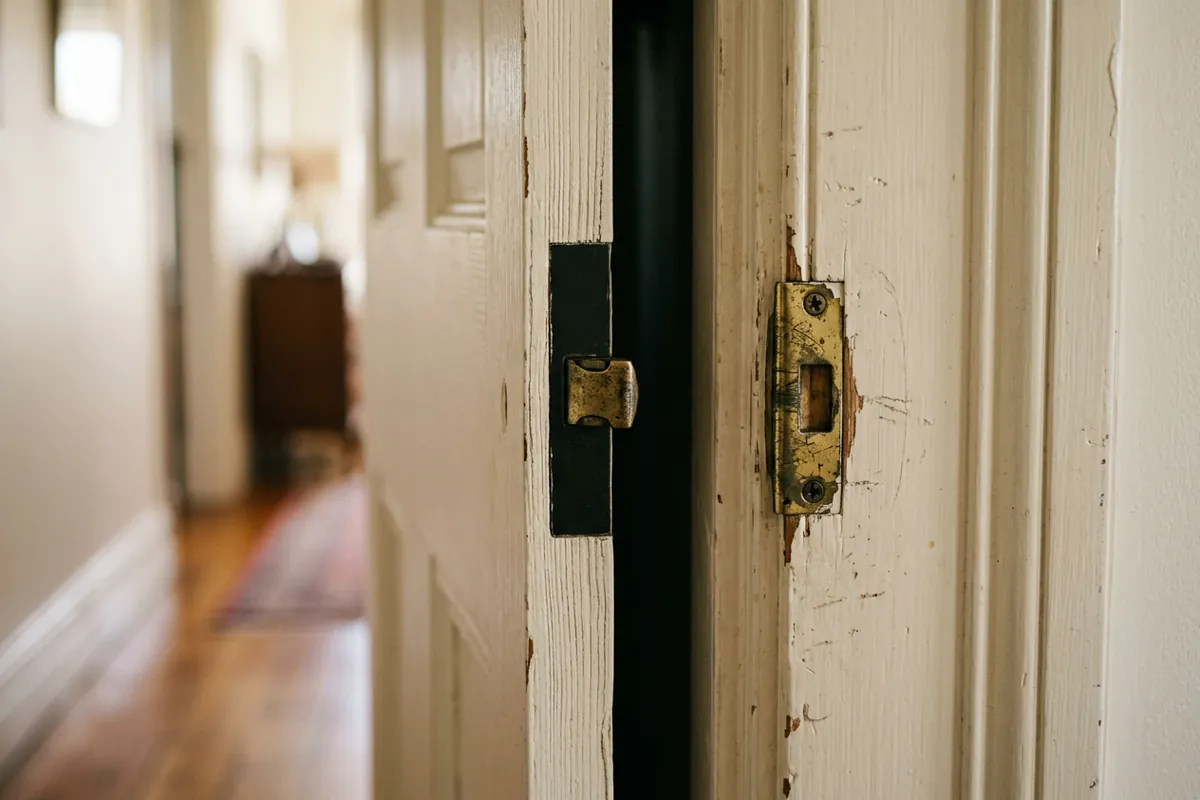
A door that will not close is usually binding on the frame, the stop or the floor. A door that closes but will not stay shut is usually a strike plate or latch problem. The usual causes of binding are moisture in the timber, loose hinge screws and a frame that has moved, and the repair is rarely just planing the edge.
Start by working out which of the two you have. Hold the handle so the latch is retracted and gently try closing the door. If it still catches, note where it touches the frame, the stop or the floor. If it closes freely, the door fits and the latch is the problem. Keep your fingers clear of the hinges, and do not remove hinge pins or hold a heavy door up on your own.
Causes to check, by symptom
The order below is a troubleshooting order and not a measured failure rate for NSW houses. Recent rain, new flooring, a recent installation or cracking elsewhere in the house changes it.
| What you notice | Likely causes, in order to check | What you can check safely | What a carpenter does |
|---|---|---|---|
| Tight only in damp weather | Moisture in the timber or a failed finish; water from a leak; too little clearance when it was hung | Look for failed paint, dampness or staining on the faces and edges. Do not force the door | Deals with the moisture, then decides whether a small trim and a full reseal are needed |
| Door has dropped, or the gap is uneven | Loose or pulling hinge screws; damaged timber behind the hinge; a loose frame | Look at the hinge leaves and screw heads. If the door is stable, snug an accessible loose screw by hand and stop if it spins | Refixes hinges into sound timber, repairs the fixing, or fits new hinges, and checks the frame joints first |
| Closes but will not latch | Door position has changed after sagging; strike plate in the wrong spot; sticking latch or handle | With the door open, check the handle retracts the latch freely. Look at the contact marks on the strike plate | Corrects the hinges and door position first, then moves the strike plate or replaces the hardware |
| Twisted or bowed leaf | Uneven moisture on the two faces; heat; product or storage problems | Sight along the door and compare the fit at top, middle and bottom. Photograph it | Assesses the cause. Replacing the door can make more sense than shaving the edges again and again |
| Frame out of shape | Loose joints, decay, or movement passing through from the building | Look at visible joints and gaps and compare with nearby doors. Do not pull off architraves | Repairs sound localised joinery and resets the frame, after establishing why it moved |
| Several doors sticking across the house | Foundation, slab or stump movement, a leaking service, changing drainage | Look for new cracks, changing floor levels and drainage problems. Do not crawl into an unsafe subfloor | Recommends a structural assessment first. Rehanging every door first is the wrong order |
None of these checks needs power, gas or water isolation on an ordinary timber door.
Moisture and trimming
Queensland's technical note on minor repairs to timber doors says moisture causes dimensional change and decay in timber, and that a sound coating is the main way to control swelling. Once the paint or sealer fails, moisture gets in. If a door swells after wet weather, check the finish and the exposure before planing.
Corinthian's care guide for its timber doors says the whole door should be finished after fitting and before hanging, including behind hardware and the top and bottom edges. A freshly trimmed edge needs sealing the same way as the faces, so a trim that leaves bare timber can set up the next round of swelling.
Do not over-plane. Product instructions differ:
- Hume's installation guide allows a maximum of 3 mm from any edge, trimmed evenly, and recommends a 3 mm gap between the door and the jamb.
- Corinthian says trimming allowances vary by range and design, and that solid doors need three hinges of at least 89 mm.
Neither rule applies to a different type of door, and neither applies to a fire-rated doorset, which needs advice specific to that door before anything is trimmed or its hardware changed. The NSW Guide to Standards and Tolerances (2017) is advisory, not a regulated standard. It treats internal door gaps below 2 mm or above 5 mm as defective within three months of completion of the building work, and it expects all sides and the top and bottom edges of a door to be sealed to the manufacturer's specification.
Hinges, then strike plate
A latch that will not catch is often the last symptom of an alignment problem. Moving the strike plate can make the door latch today and leave loose hinges or a moving frame untouched. The sensible order is hinge fixings, then the position of the door, then the frame, then the latch and strike. Queensland's note tells the repairer to check that hinges are properly fixed, that screws are not pulling out and that the frame has no loose joints, and to refix the screws and repair loose joints.
If the door is stable and still will not latch, the strike plate and keeper opening can be adjusted. Latch types differ (spring latch, mortice lock, multipoint lock, powered strike), so do not assume one adjustment method suits all of them.
When it is the building
A sticking door does not on its own show structural failure. CSIRO's BTF 18 describes doors catching at the floor, the head or the side of the frame as one pattern of building movement, and its damage categories list slightly sticking doors and windows under Category 2, with crack widths under 5 mm. It lists sticking doors, fractured service pipes and impaired weathertightness under Category 3, with cracks of 5 to 15 mm or several of 3 mm or more in a group. Do not read a crack width in isolation, and do not apply the wall categories to cracks in a concrete slab.
Get advice sooner if the sticking is new and getting worse, affects several doors, or comes with grouped cracks, changing floor levels, a distorted frame, a leaning wall or damaged pipes. Photograph and date what you see. CSIRO also notes that a leaking water, sewer or stormwater pipe can saturate foundation soil, and says to fix the leak. Do not soak the perimeter of the house or remove a large tree without advice. Moisture under the house is covered in subfloor ventilation and damp.
Which trade
A carpenter handles door fit, hinges, frames and the latch. A locksmith can deal with a lock mechanism. Electrical work, such as an electrically operated strike or concealed wiring, needs a licensed electrician, and a leak needs a licensed plumber. In NSW a contractor licence is required for carpentry work above $5,000 including labour, materials and GST, a threshold that applies to licensing and is not an estimate for a door repair.
If the frame itself has rotted at the bottom, see door frame rot repair. If a new door is needed, what it costs to hang a new internal door has the figures. Our doors and windows page covers what we do.
Book a look
Tell us which door, whether it binds or will not latch, and whether other doors in the house are also sticking. Call Dave on 0414 007 351 or use the contact page.
Sources
- Minor repairs to timber doors, Queensland Government technical note
- How to install a door, Hume Doors
- Door care and maintenance, Corinthian
- Foundation maintenance and footing performance (BTF 18), CSIRO
- Guide to Standards and Tolerances 2017, NSW Government
Common questions
Why do I have to push my door hard to close it?
The door is binding on the frame, the stop or the floor. The usual causes are timber that has swollen with moisture, loose hinge screws that have let the door sag, or a frame that has moved. Queensland's technical guidance on timber doors warns against forcing a binding door, so find where it touches first.
Why is my door not closing properly?
First work out whether it binds or whether it reaches the stop but will not latch. Hold the handle so the latch is retracted and gently close the door. If it still catches, the fit is the problem. If it closes freely, look at the strike plate and the latch.
Will WD-40 help a swollen door?
Not with the swelling. A swollen door is tight because the timber has taken up moisture, and the repair guidance points to the moisture and the paint or sealer on the door. A lubricant on the latch can help a stiff latch, but it does not change the size of the door.
Will a swollen door go back to normal?
Sometimes. Timber changes size with moisture, so a door that only sticks in wet weather may ease when conditions settle. If the finish has failed, or water is reaching the door from a leak, it will keep swelling until that is fixed. Check that every edge of the door is sealed before anyone trims it.
What could be the reason why my door latch is not staying closed?
The usual reasons are that the strike plate no longer lines up with the latch after the door has sagged, the strike plate was fitted in the wrong spot, or the latch or handle is faulty. Fix the hinges and the position of the door first, then adjust the strike plate.
How much can be planed off a door?
It depends on the door. Hume's installation guide allows a maximum of 3 mm from any edge, trimmed evenly on both sides, and Corinthian says trimming allowances vary by range and design. Check the instructions for the actual door before anything is planed.
How expensive is it to fix a door latch, or a door that will not close?
It depends on the cause, and a quote comes after someone has seen the door. For reference, hanging a new internal door into a true frame is $150 to $300 a door in labour, with the door on top, as set out in our internal door cost guide. Adjusting hinges or a strike plate is smaller work than that.
Want a hand with this at your place? Get a free quote or call 0414 007 351.