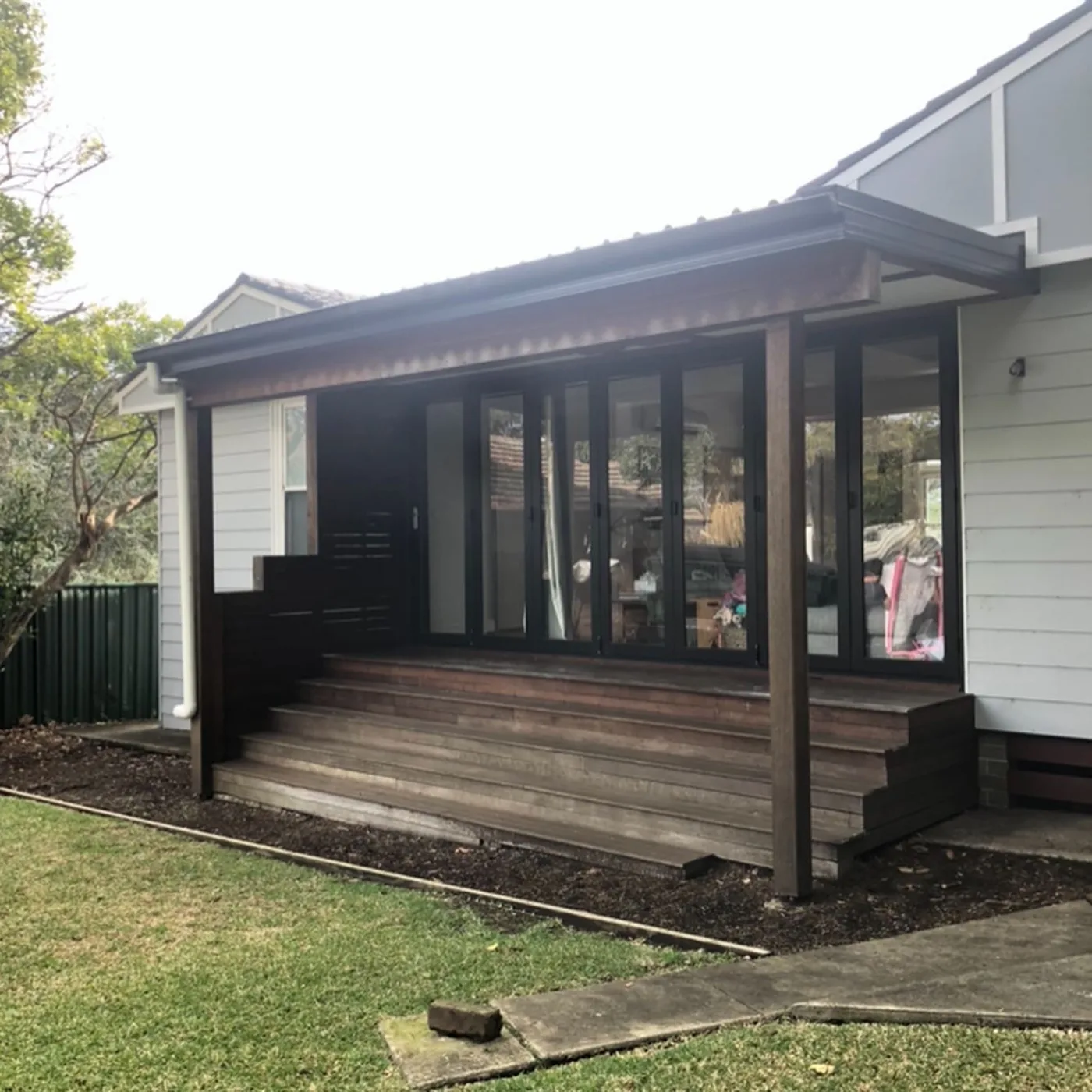
Three painters looked at a place in Bulli last autumn and only one of them sent a price back.
The one who did had a line in it I thought was fair enough. Quote assumes all substrate sound, timber repairs by others. Which is painter for: I'm not touching those boards, and I'm not wearing it when the paint lifts in two winters.
The owner rang to ask what that actually meant. It meant the western wall had about nine soft spots in it and every bloke who'd been up the ladder had seen them and quietly decided it wasn't his problem.
We don't paint, and that isn't a dodge
Worth saying up front, because we get asked about repaints often enough.
We're carpenters. Painting is its own trade with its own ticket in this state, sitting as a separate category from carpentry on the NSW building and trade licence list. I'd rather put you onto someone who rolls houses every week than have a crack at yours between jobs.
Our half is the part that comes first. Boards, sills, cut ends, and whatever framing behind them has gone soft. On a splice or a small patch I'll prime and paint the repair so it matches what's around it, because leaving a raw scarf joint for the next bloke to find isn't finishing the job. A whole elevation, or a whole house, is a painter's work, and I'll tell you that straight instead of pricing it.
The paint is doing more than you think
Here's the bit that reframes the whole conversation.
Cladding isn't a waterproof wall with a colour on it. Your Home, the federal guide, puts it about as plainly as you could ask for: cladding materials are rarely waterproof. They're weather resistant. They act as a barrier to water getting in rather than something that stops it outright. On timber boards the coating is a working part of that barrier, not decoration.
So a repaint isn't a facelift on an old weatherboard house. It's maintenance with a deadline, and the deadline is however long the last film lasts. Once it cracks along a board edge the timber underneath starts drinking, and you've gone from a painting job to a carpentry job without doing anything at all.
Which is why prep isn't the annoying part before the good part. Prep is the job.
What gets sorted before a brush comes out
The screwdriver test does most of the work. Push it into the bottom edge of the boards, the ends where they butt a corner, under every window, and anywhere a downpipe runs close. Sound timber stops it dead. If it sinks, mark it.
Cut ends are the ones people miss. Every board that's been trimmed on site has raw end grain, and if that went up unprimed forty years ago it's been wicking water the whole time. You'll usually find the softest timber within a hand's width of a joint or a corner, not out in the middle of a board where you'd expect it.
Then the sills. A window sill with no drip groove throws water back against the wall instead of off it, so the board directly under it copes with every shower twice. Same story where a downpipe empties against the cladding instead of into a stormwater line, and I've moved more downpipes on repaint prep jobs than I can count. That's the cheapest repair on the whole list and the only one that stops the problem repeating.
Nail heads matter too, in a boring way. Old face-fixed boards work loose, and a proud nail head means a bump the roller skips and a rust spot that bleeds through the new colour by the second summer. They get punched and filled. If they're bright steel and weeping already, they get pulled and replaced with galvanised or stainless, because anywhere between Helensburgh and Nowra the salt takes the fixings well before it takes the timber.
Last one, and it's free: whatever is stacked against the wall comes away from it. Garden beds banked up over the bottom board, a path poured hard against the cladding, a sprinkler hitting the same two metres every morning. Paint won't outlast any of that.
Which boards get repaired, and which get replaced
That call is its own conversation and I've been through it properly in splice one, or replace the run, including the thing to check first on anything built before about 1990. Short version for prep purposes: a soft patch of a metre or so with sound timber either side is a splice, rot that has climbed through several overlapping boards is a run, and a new board fixed to a rotten stud is decoration.
The reason it comes up on a repaint is timing. Once the scaffold or the ladders are up and the old paint is off, that's the cheapest hour anyone will ever have for looking at those boards properly. Finding a bad stud after the first coat is on is how a tidy job turns into an argument.
Getting the order right
Carpenter, then painter. Not the other way round, and not both at once.
I've turned up to walls with fresh undercoat on them where nobody had checked underneath, and it's a waste of somebody's money every time, because half of what I then cut out was painted three days earlier. The other version, where the painter is booked for a Monday and the carpentry runs long, is just as bad. Repairs need to be primed and given a bit of time before a topcoat goes over them.
Give the painter a wall that's sound, filled, sanded and primed and you'll get a better price from them as well. They're pricing risk when they can't see what's under the film, and a wall somebody has already been through is a wall they can quote flat.
If the eaves and fascias are part of the same repaint, they want looking at in the same visit for the same reason. There's a whole post on replacing fascia and gutters, and on an older house that work carries the same pre-1990 caution the cladding does.
What it comes to
I'm not going to put a per-metre number on prep, because it isn't one job. It's however many soft spots you've got, which nobody knows until someone walks the walls with a screwdriver.
What I can tell you is what moves it. How far the rot climbed. Whether the studs behind are involved. Whether the boards are a profile still sold, or one that has to be machined or robbed from a hidden wall. Ladder work versus scaffold. And access, always access, because the wall a metre off the neighbour's fence costs more than the one facing the street.
A handful of splices and some making-good is property maintenance work, and it's usually cheaper to bundle it in with whatever else has been waiting while I'm already on site. A full elevation sits outside that. Once the whole job passes $5,000 it needs a licensed builder and a written contract in NSW, and the licence is worth checking yourself rather than taking a business card at face value.
The Bulli wall came to seven boards, two sill repairs, a downpipe moved off the cladding, and a morning of punching and filling. The painter who'd written the disclaimer came back, priced it flat the second time, and had the house done the following week.
If you're getting repaint quotes and one of them has a line about substrate in it, that line is the actual job. Ring Dave on 0414 007 351, or send a few close-up photos of the bottom edges, and we'll sort out how much carpentry is sitting under that paint before you book anyone.
Want a hand with this at your place? Get a free quote or call 0414 007 351.