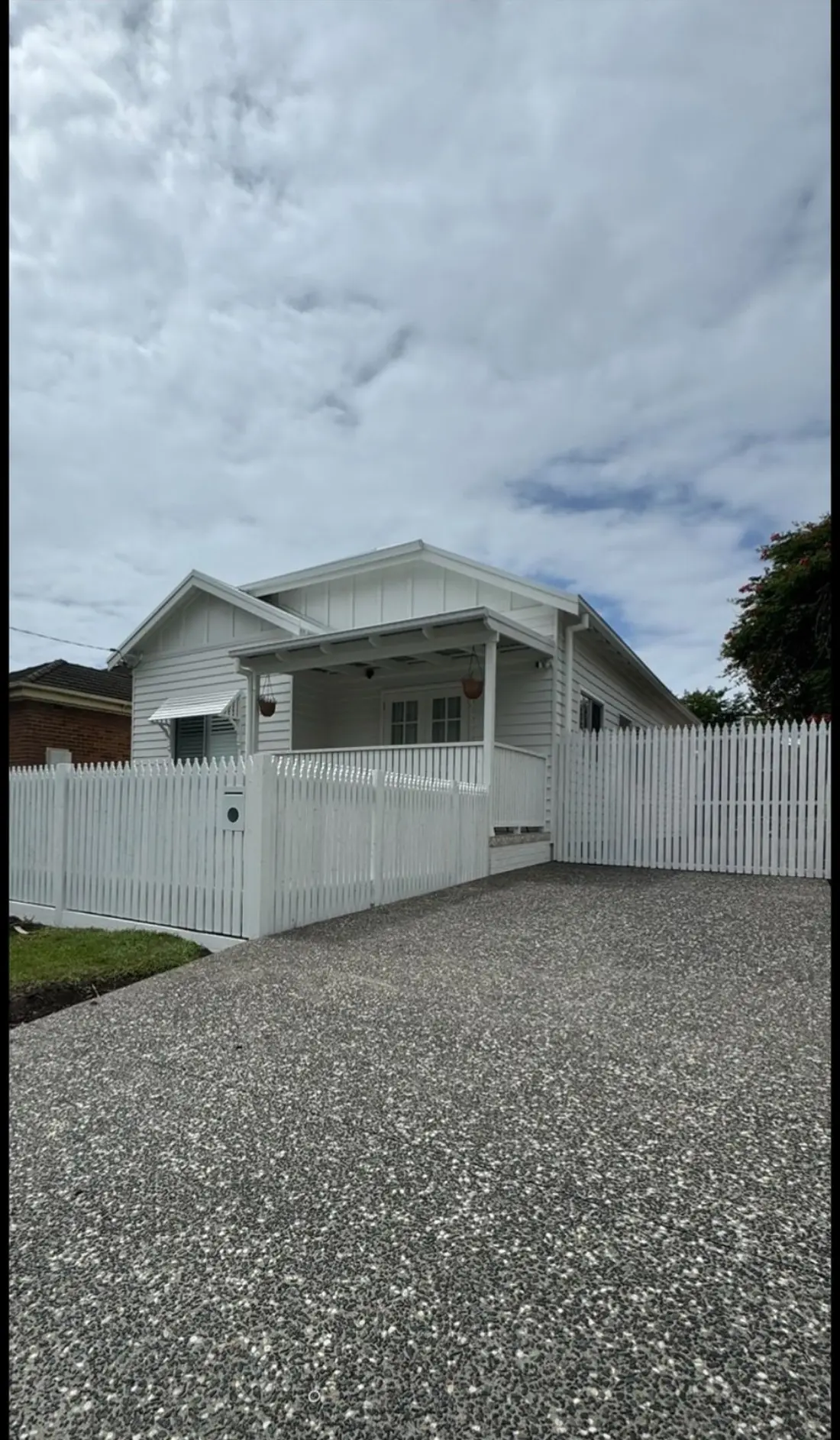
I've lost count of how many times someone has pointed at one soft board under a window and asked whether I could swap it out while I'm there anyway.
Fair enough. It's one board. The paint has blistered along the bottom edge, there's a dark line where the water sat, and if you push a thumb into it the timber gives like wet cardboard. Half a morning, surely.
Then you take it off and the one above it is worse, because everything that got in ran down behind the board you could actually see.
A place at Woonona last winter, western wall, and the owner had painted over the bad patch twice hoping it'd hold. By the time the second board was off there were four gone and the stud behind the middle two had a soft face on it. She'd have been better off ringing someone the first time the paint lifted, and she knew it, and she said so about six times while I was up the ladder.
First question: is it even timber?
Before quotes, before colours, before anyone buys a board.
A lot of what gets called weatherboard around here isn't. Post-war Illawarra is full of fibro, and a good chunk of that fibro was pressed and painted to read as weatherboard from the street on purpose. Asbestos cement planks were sold for exactly that. From the footpath, painted, seventy years on, you genuinely cannot tell the difference.
The tells are all up close. Timber has grain that shows under raking light, especially where the paint has worn thin. Cement sheet doesn't, and the cut edge is a chalky grey rather than a fibrous one. Timber boards get face-nailed at irregular spots by whoever hung them; sheet gets fixed on a neat grid. Knuckle a board and timber sounds like timber. Sheet sounds dead.
That said, I've been wrong. Painted boards under a verandah, low light, a hot afternoon, and I've called it timber and been out. If the house went up before about 1990 and there's any doubt, we get a sample tested before a saw goes anywhere near it. SafeWork NSW sets out what you can and can't do yourself, and the short version is: don't grind it, don't sand it, don't cut it, don't take to it with a demo bar on a Saturday because a quote came in higher than you liked. It's the same rule that applies to old eaves lining, which I've gone through in the fascia and eaves post.
Testing costs a day's delay. Guessing costs a lot more than that.
Splice, or replace the run
Assuming it's timber, here's how the call actually gets made.
Splice it when the rot is confined to a stretch of a metre or so on one or two boards, and there's sound timber either side to land a joint on. We cut back to the middle of a stud, scarf in matching board, prime the end grain properly — that's the bit that gets skipped and it's the bit that decides whether you're back here in four years — then fill, sand and prime ready for a painter. That's small money. Same order as splicing a rotten window sill, which I've priced out in the timber window post, and for the same reasons.
Replace the run when the rot has climbed. Boards overlap, so water that gets behind one travels down through several, and by the time three or four are soft you're paying for the setting-out and the ladder work over and over on a wall you'll end up redoing anyway. Also replace when the studs or noggings behind have gone soft, because a new board screwed to a rotten frame is decoration.
And there's a middle answer people forget: one elevation. The western and southern walls cop the weather down here and the northern one often looks brand new. Nobody needs a whole house reclad because one side has had it. I'd rather do the bad wall properly this year and look at the rest in a few years than talk you into four sides.
The profile problem nobody warns you about
Here's the one that turns a simple job awkward.
The boards on an older Illawarra house were milled to profiles that largely aren't sold anymore. Rusticated, splayed, chamfered, all sorts, and the reveal on them — how much of each board shows below the one above — varies house to house. A modern dressed pine board sitting between two 1940s boards reads wrong from thirty metres away even when it's a perfect fit, and once you've noticed it you can't stop noticing it.
Three ways out of it. You have new stock machined to match, which is worth it on a front elevation and hard to justify on a back one. You go looking for the same profile secondhand, which sometimes works and sometimes wastes a fortnight. Or you rob boards from somewhere nobody looks — under a verandah, behind the carport, the wall the neighbour's garage blocks — and put the new mismatched stock there instead. That last one is the trick, and it's free, and I use it more than the other two put together.
Worth asking about on any quote. If a price looks light on an old house, the profile is usually the thing that hasn't been thought about yet.
Paint is not decoration on a weatherboard house
The bit I'd most want a homeowner to walk away with isn't the pricing, it's this.
On timber cladding the paint or oil is doing the actual waterproofing. It's not a finish sitting on top of a waterproof wall. The government's own Your Home guide puts it plainly: an applied finish such as paint provides most of the water resistance, and timber weatherboards need repainting or refinishing to stay sound. Let the film go and the board starts drinking.
So the rot almost always starts where the paint film breaks first. The bottom edge of a board, which nobody rolls properly because it's awkward. Cut ends that went up unprimed. Behind a downpipe that discharges onto the wall instead of away from it. Under a window with no drip on the sill, so every drop runs back and sits along the top edge of the board below.
Then there's the stuff we do to ourselves. Garden beds banked up against the cladding so the bottom row is buried in damp mulch. A concrete path poured hard against the wall years after the house was built. A sprinkler that hits the same two metres of weatherboard every second morning at six. I pull soft boards off walls in Corrimal and Thirroul all the time where the cause is sitting right there in the garden and has been for a decade.
Salt does the rest. Anywhere from Helensburgh down to Nowra the fixings go before the timber does, and cheap bright nails bleed rust streaks down a freshly painted wall inside a season. Galvanised or stainless, always, and it costs a few dollars.
Who does what, and the licence bit
We do the boards and any framing behind them, which is carpentry proper once studs are involved. Boards go up primed and sealed, not finish-painted, on most quotes including ours — that needs a painter afterwards, or you do it yourself, and if it isn't written down it becomes an argument later. Asbestos removal is a licensed job and not ours.
A couple of boards and a bit of making-good is a running-repair job and sits happily under property maintenance alongside the sticking doors and the dodgy back step. A full elevation isn't. Anything over $5,000 all up needs a licensed builder and a written contract in NSW, so ask to see the licence before you hand over a deposit.
The Woonona wall came in at eleven boards, one stud face spliced, and a downpipe moved 400mm so it stopped watering the cladding. Two days. The downpipe was the cheapest part of it and the only part that stops it happening again.
If you've got a board that gives under your thumb, or paint lifting in a line along the bottom of one, get someone to look before summer. Ring Dave on 0414 007 351 or send through a photo taken close up, in raking light and I'll tell you honestly if it's a board or a wall.
Want a hand with this at your place? Get a free quote or call 0414 007 351.