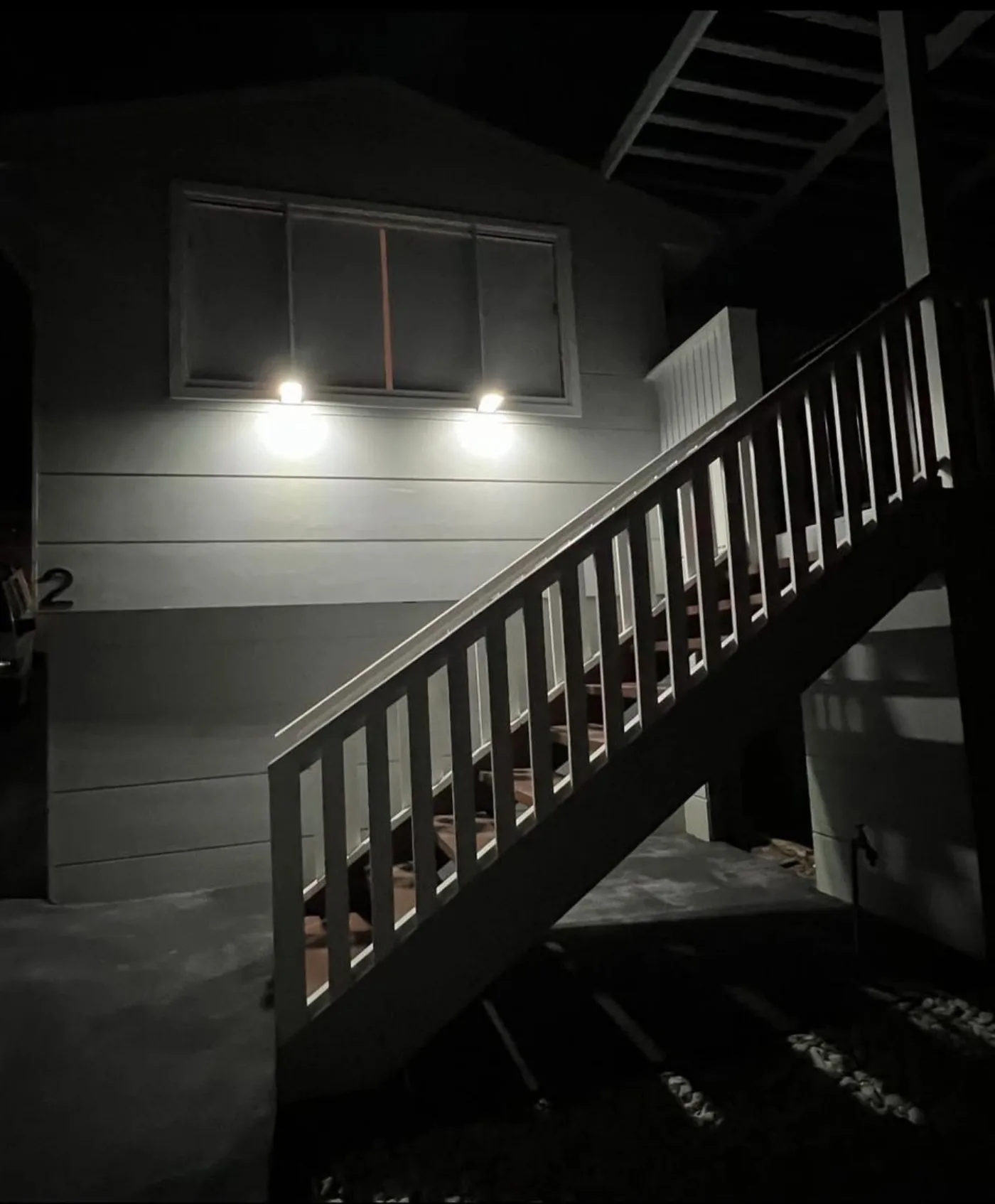
Run a tape from the ground up to the landing on an old set of back steps, divide it by the number of risers, and see whether the answer matches what's actually built there. Around here it often doesn't. One step ends up thirty or forty millimetres out from the rest, and that's the one everybody in the house has quietly learned to skip without ever deciding to.
The set at Balgownie had two of those. It also had four treads, a small landing, and two posts rammed straight into the dirt sometime in the late eighties. I'd been called out to replace one broken tread, second from the bottom, which the owner's mum had gone through the week before. Bruised shin, wounded pride, and a two-year told-you-so she was enjoying enormously.
The tread that broke wasn't the problem. It was just the first one to go. That's how most stair jobs start down here.
What a set of stairs actually costs
Depends enormously on which set you mean, so here's the three that come up.
Back steps off a laundry or a low landing, three or four risers, treated pine, on new footings: $1,200 to $2,500. That's the small one, a day's work for most blocks, and it's the job I do most.
An external flight up to a raised deck or a first-floor landing, eight to twelve risers, with a landing and a compliant balustrade: $4,000 to $9,000. The escarpment suburbs are full of these. Anywhere the ground falls away out the back, there's a timber stair doing a job it was never really built for.
A full internal staircase replaced in an existing house: $5,000 to $12,000 for a straight painted flight, and $12,000 to $25,000 once you're into hardwood treads, a feature stringer, or anything that turns or winds. Internal stairs cost more than they look like they should because you're working inside a finished house, around plaster and floor coverings, and every cut has to be right the first time.
Balustrade on its own, if the stair is sound and it's only the rails that have had it, runs about $200 to $450 a lineal metre depending on the timber and the detail.
And a single tread swap, which is what half of you came here for, is $150 to $350 a step once someone's on site. Cheap. Just don't assume one is one.
The measurement that sets the price
Here's the bit that decides whether your stairs can be rebuilt where they stand or have to be reset entirely.
Every step has a rise (how far up) and a going (how far forward). Under the National Construction Code those have to sit inside a range, and more importantly they have to stay consistent within a few millimetres right up the flight. Your foot learns the rhythm on the second step. Break it near the top and that's how people fall.
Plenty of the older stairs around Wollongong were built to whatever suited the day. I've measured flights with a 210mm rise at the bottom and 165mm at the top, because someone poured a path at the base years later and never adjusted anything above it. That set can't be repaired into compliance. The whole thing has to come out and be set out again from the finished ground to the finished landing.
So when I turn up, the tape comes out before anything else. Total rise from the ground to the deck or floor, divided into equal steps, and then we see whether your existing stringers can carry that or not. It's a five-minute check and it usually answers the question of repair versus replace before we've talked about timber at all.
Where the rot hides on an outdoor stair
Same story as decks, and for the same reason. Water sits where you can't see it.
The bottom of the stringer, where it lands on the concrete or, more often round here, into the soil. Posts buried straight in the ground with no stirrup. The back of a tread where it meets the riser and never dries out. Under the bullnose. Give the stringer a shove and push a screwdriver into the base of every post before you spend a cent on new boards.
Salt air does the rest. Fixings go first close to the coast, and I've pulled apart stairs at Austinmer where the timber was fine and every bracket had rusted through. Same failure I go through in the restore or replace piece on decks, because a stair is a deck standing on its end.
New ones we build with the posts on galvanised stirrups, up off the concrete, stainless or heavily galvanised fixings anywhere near the water, and treated pine or a durable hardwood depending on where it sits and what it has to look like. There's more on picking between those two in the hardwood versus treated pine post.
Balustrades, and the number that catches people out
If the stair or landing sits more than a metre above the ground you need a compliant balustrade, and the gaps generally can't let a 125mm ball through. That rules out a lot of the old widely-spaced rails on Illawarra back stairs, and it rules out the ones where the timber has shrunk and the balusters have worked loose.
People get filthy about this because the balustrade often costs more than the steps. It's also the only part of the job that stops someone going over the side, so I won't build a set without one where the rules say it needs one. If budget is tight I'd rather build a plainer stair with a proper rail than a nice stair with a rail you can shake.
Internal stairs, which are a different animal
Two things drive the number inside a house.
The first is whether the opening in the floor above is staying put. If it is, we're working to a fixed total rise and a fixed landing and the job is joinery. If the opening is moving, or the stair is going somewhere it wasn't, you're cutting into floor framing and that's structural work with an engineer and approvals attached. Same territory as taking out a load-bearing wall, and it's worth knowing which one you're in before you get quotes.
The second is the making-good. Pulling an old flight out takes plaster, skirting and usually some flooring with it. A quote for the stair alone is not a quote for a finished stairwell, and that gap surprises people every time. Ask what's included and what's coming back after.
Who's allowed to do it
Anything over $5,000 all up needs a licensed builder and a written contract under the NSW rules. Most full stair replacements clear that comfortably. A single tread or a wobbly rail doesn't, so a good handyman can sort those, and we do plenty of exactly that under property maintenance.
Structural stairs are carpentry proper, though. Stringers, landings, connections back into the house frame. Ask to see the licence and ask who's actually doing the setting out, because that's the part that decides whether the thing feels right underfoot in ten years.
The Balgownie steps ended up a full rebuild, which the mum had been predicting for two years and enjoyed being right about. Four risers, new posts on stirrups, hardwood treads and a rail she can actually lean on.
If there's a set at your place that flexes, creaks, or drops away at one corner, that's worth a look before someone finds it the hard way. Ring Dave on 0414 007 351 or send through a photo of the bottom of the stringer and I'll tell you whether it's a tread or the lot.
Want a hand with this at your place? Get a free quote or call 0414 007 351.