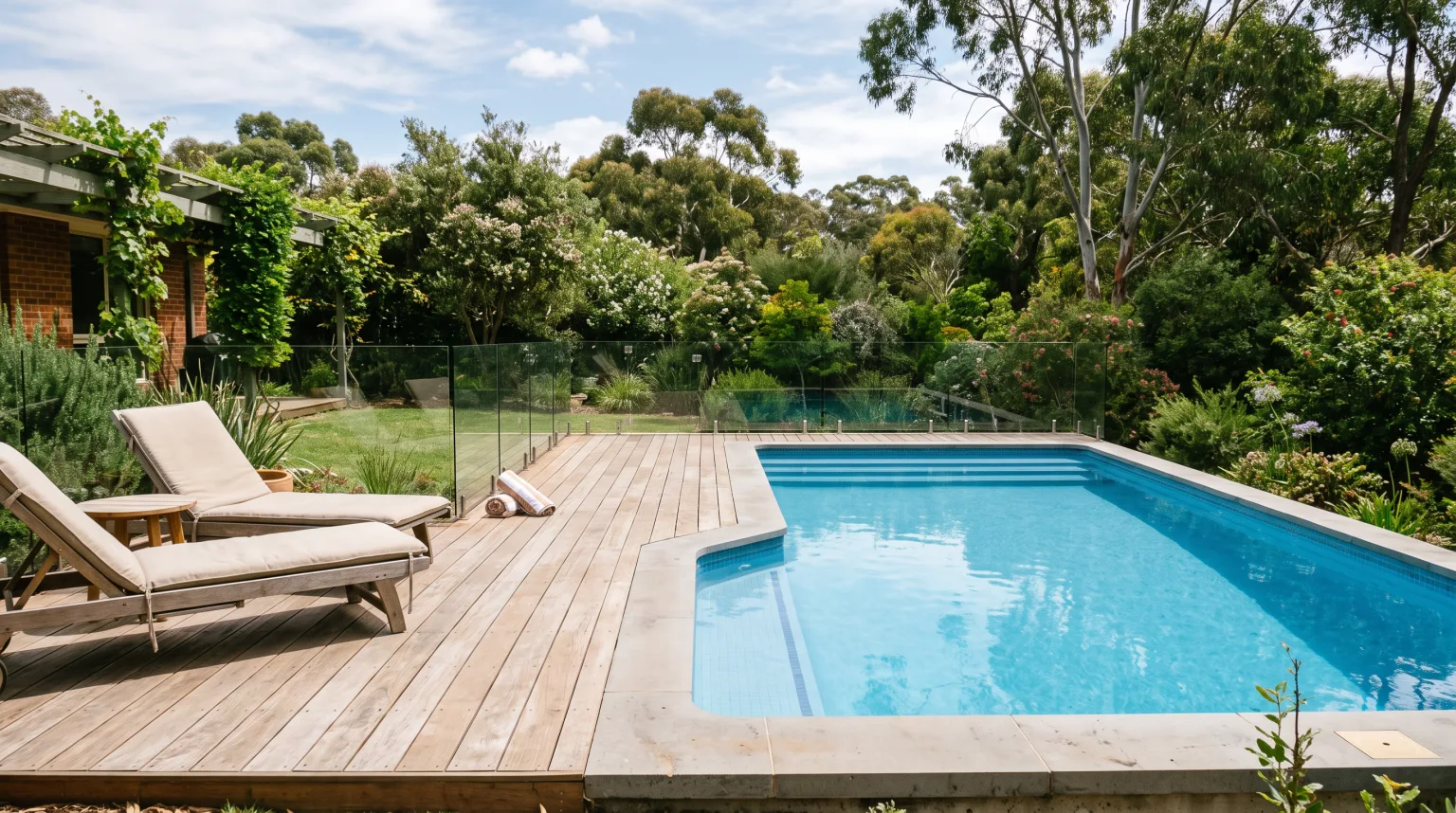
A deck around a pool costs more than the same size deck anywhere else on the block, mostly because of three things that come with a pool and don't come up on an ordinary deck. The boards need to handle bare wet feet without going slippery, the deck usually forms part of the pool's safety barrier, and a certifier has to sign off on that barrier before anyone's allowed to swim in it. Each of those adds cost on top of the standard per-metre rate.
The base rate still applies
A pool deck starts from the same numbers as any other deck. Around the Illawarra that's roughly $350 to $500 a square metre for treated pine and $500 to $750 for merbau or spotted gum, supplied and built, with the full breakdown of what moves that number in what a new deck costs. Composite sits higher again, and if you're set on composite specifically for the pool surround, good boards run $90 to $160 a square metre for the surface alone on top of the frame underneath.
What's different is everything that gets added to that base rate once the deck's next to water.
Slip resistance, not just looks
Around a pool, the deck cops constant splash and bare wet feet, and that changes what timber makes sense. Composite handles it well: no oiling washing into the pool, no splinters, and it doesn't go slippery-green the way a neglected hardwood board can. If you'd rather stay with timber, spotted gum holds up better than merbau in that environment, though you'll need to stay on top of the oiling to keep the surface from going slick.
That decision, timber or composite, and which timber, is a whole topic on its own, and merbau vs composite decking goes through it properly. The short version for a pool surround: composite costs more up front and gives you back the maintenance; timber costs less up front and asks for an annual oil if you want it to keep performing underfoot.
The barrier rules that come with a pool
Every pool in NSW needs a compliant child-resistant barrier under the Swimming Pools Act, built to the Australian Standard for pool fencing, and a deck that runs alongside or forms part of that barrier has to respect it rather than undermine it. That means the deck can't create a foothold that makes the barrier climbable, gates into the pool area need to self-close and self-latch, and the whole thing needs a principal certifier's inspection before the pool can legally be used. NSW Fair Trading's guide for pool owners sets out the registration, certification and barrier obligations in full, and it's worth a read before you finalise a deck design that sits anywhere near a pool boundary.
Practically, this is where a pool deck's cost shows up that a standard deck's doesn't. Getting the barrier detail right the first time, correct gap sizes, a gate that swings the right way, no shelf or handhold on the pool side, is the difference between a certifier signing off straight away and coming back a second time, which costs you both the inspection fee and the delay. Sloping blocks and pool surrounds is where we've set out how we handle that on a build.
What doesn't change
The frame underneath a pool deck is built the same way as any other deck: proper footings, bearers and joists sized for the span, stainless or coated fixings given how much of the Illawarra cops salt air regardless of the pool. None of that gets cheaper or more expensive because there's water nearby. It's the surface and the barrier that carry the extra cost, not the structure holding it up.
If you're planning a deck around a pool anywhere from Helensburgh down to Nowra, ring 0414 007 351 or send through the contact form. Dave will walk the block, talk through timber or composite against your budget, and give you a fixed quote that accounts for the barrier from the start rather than as an afterthought.
Want a hand with this at your place? Get a free quote or call 0414 007 351.