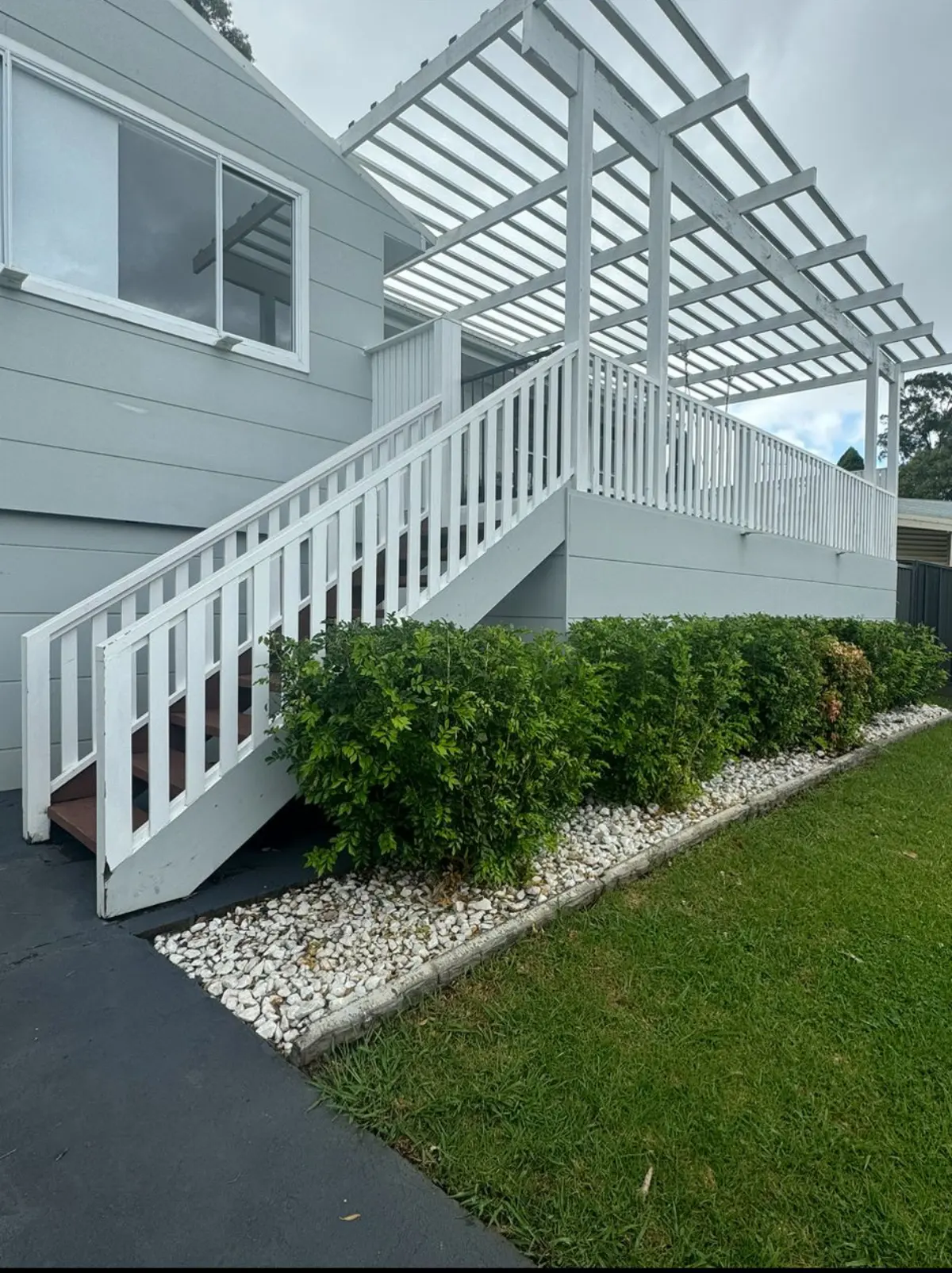
Half the calls we get start with "I want a merbau deck." Fair enough — most people have only ever heard of merbau. But it's not always the right board for the spot, and once you factor in how close you are to the water and how much weekend you're willing to give up to oiling it, the answer sometimes changes.
Four boards cover nearly every deck out here. Here's the honest rundown on each.
The four boards most Illawarra decks get built from
Merbau. The default, and for good reason. Dense hardwood, stocked at every Bunnings from Unanderra to Nowra, and the cheapest of the proper hardwoods. Oil it and it comes up rich and warm — genuinely a good-looking board. The catch is tannin. New merbau bleeds a rust-coloured stain for the first few rains, and that stuff grabs onto render, white pavers and concrete and doesn't let go. Got a path or a rendered wall under the deck? Plan for it, or you'll be scrubbing. It also greys off if you skip the oil for a year or two. Reckon on $5–$7 a lineal metre for the board, depending on width and what the yard's doing that week.
Spotted gum is the step up. Harder than merbau, a lighter honey-brown, and it shrugs off salt air — which is exactly why you see so much of it on the decks down at Thirroul, Austinmer and Kiama. Less tannin drama, too. You pay for that: a fair bit more per metre, and it's a tougher board to drive a screw into, so it's no bargain. Near the coast, though, it earns it.
Treated pine is the budget play. Two grades matter. H3 is your above-ground decking board. H4 is for anything in or near the dirt — posts, bearers, the lot. Mix those up and the timber rots from the ground up while the top still looks fine. Pine's soft and it'll mark if you drop a planter on it, but it's cheap and it goes down quick. Don't try to oil it like a hardwood. Paint it or hit it with a solid stain — it looks better and lasts longer that way. Good for a big deck on a tight number, a rental, or anywhere you're happy to repaint down the track.
Composite is the never-oil-a-deck-again option. Wood-plastic board. You hose it, you don't sand it, you don't coat it, and it won't grey or splinter on you. That's the pitch. Two real downsides. It stings up front — often two to three times the merbau board price. And the dark colours get savage underfoot in summer. Stand on a charcoal composite deck barefoot in a Gong heatwave and you'll learn your lesson once. Full sun? Go a lighter colour.
Salt air and pool surrounds change the answer
Live near the water — and a lot of the Illawarra does — and salt is the quiet killer. It eats cheap fixings and dries timber out faster than it should. So whatever board you land on, the screws and brackets matter every bit as much as the deck. Near the coast we use stainless or properly coast-rated coated fixings. Standard galv just doesn't go the distance out here; give it two years and you've got rust streaks running down every board.
Pools are their own beast. The board cops constant splash off chlorinated or salt water, and people are on it with bare wet feet. Composite makes a lot of sense around a pool for that exact reason — no splinters, no annual oiling, and it doesn't go slippery-green as quick. Set on timber there? Spotted gum holds up better than merbau, but you'll have to stay on the oil.
Rough guide to who suits what:
- Tight budget, happy to repaint — treated pine, painted
- Best-value hardwood, don't mind re-oiling — merbau
- Near the surf or a pool, want it to last — spotted gum
- Want to never oil a deck again — composite
What is MarinePlank decking, and is it worth it here?
MarinePlank is a hardwood decking profile made by Mortlock Timber, not a treated pine board. The top is machined with a slight dome so water runs off instead of sitting on the board, and it comes in heavier-duty species like spotted gum, blackbutt and ironbark, in 85mm and 130mm widths.
It's surface-fixed, two screws per board per joist, so it goes down like any other hardwood deck. The pitch is the run-off and the tougher species for exposed, wet or high-traffic decks, which is exactly the situation on a coastal block from Austinmer down to Kiama.
Is it worth it? It's a premium board you order through a timber merchant rather than pick up off the rack, so expect to pay more than off-the-shelf merbau and to wait for it. On a big exposed deck near the surf where you want a hardwood that copes, it's a fair option. On a sheltered suburban deck, standard spotted gum does the same job for less.
What timber to use for a decking frame
Use H4 treated pine for posts, bearers and anything in or near the ground, and at least H3 treated pine for joists that sit clear of the dirt. The boards on top can be whatever you like. The frame is where rot starts, so that's the part to get right.
On a coastal Illawarra block we'd go H4 through the whole frame and keep it off the ground on galvanised stirrups rather than setting posts in concrete. Hardwood bearers and joists are an option when the deck is high and the spans are long, but they cost more and they're overkill under most suburban decks. There's more on that trade-off in hardwood vs treated pine.
Fixings matter as much as the timber. Stainless or coast-rated coated screws and brackets near the water, hot-dip galvanised further inland. Standard galv rusts out in a couple of years by the beach and streaks the boards above it.
So which one for your place?
It comes down to two questions. What's the budget, and how honest are you about the upkeep? Re-oil every spring and merbau gives you the best look for the money. Know you won't touch it? Composite or painted pine saves you the guilt. A stone's throw from the beach? Spend the extra on spotted gum and decent fixings and you won't be pulling it up in five years.
Most of what we build out here is merbau or spotted gum, with composite when someone's dead set on zero maintenance. No single right answer. Depends on your block, your budget, and how the deck's going to get used.
One more thing. A tired deck isn't always a tear-out. Plenty we get called to just need new boards over sound bearers, or a re-level and a re-oil. Dave will tell you straight which way it should go rather than quote a full rebuild you don't need — that's the deck repairs and restoration side of what we do, and it's usually the cheaper road.
Sorting out a new build, or a deck that's seen better days and might only need repairs and re-boarding? Give us a bell. We're local, fully licensed and insured, and we cover the whole Illawarra from Helensburgh down to Nowra. Call 0414 007 351 or send the form through for a free quote and we'll work out what actually suits your place.
Common questions
- What timber should I use for decking?
- Four boards cover nearly every deck out here. Merbau is the default and the cheapest of the proper hardwoods. Spotted gum is the step up and shrugs off salt air, which is why you see so much of it at Thirroul, Austinmer and Kiama. Treated pine is the budget play, painted or solid-stained rather than oiled. Composite is the never-oil-it-again option. It comes down to the budget and how honest you are about the upkeep.
- What is the best timber for a deck near the beach?
- Spotted gum. It is harder than merbau, a lighter honey-brown, and it handles salt air with less tannin drama. You pay more per metre and it is a tougher board to drive a screw into. The fixings matter just as much — near the water use stainless or properly coast-rated coated screws and brackets, because standard galvanised rusts out in a couple of years and streaks every board below it.
- What timber should a decking frame be?
- H4 treated pine for posts, bearers and anything in or near the ground, and at least H3 treated pine for joists that sit clear of the dirt. On a coastal Illawarra block we would run H4 through the whole frame and keep it off the ground on galvanised stirrups rather than setting posts in concrete. The frame is where rot starts, so that is the part to get right — the boards on top can be whatever you like.
- Is MarinePlank decking worth it in the Illawarra?
- It depends how exposed the deck is. MarinePlank is a hardwood decking profile from Mortlock Timber, machined with a slight dome on top so water runs off instead of sitting on the board, and available in heavier species like spotted gum, blackbutt and ironbark in 85mm and 130mm widths. It is a premium board you order through a merchant rather than pick up off the rack, so expect to pay more and wait. On a big exposed deck near the surf it is a fair option. On a sheltered suburban deck, standard spotted gum does the same job for less.
- Why does a new merbau deck stain the pavers?
- Tannin. New merbau bleeds a rust-coloured stain for the first few rains, and it grabs onto render, white pavers and concrete and does not let go. Hose a new merbau deck down a few times over a couple of weeks and let it purge before the first coat of oil goes on. Kapur does the same thing. Spotted gum is much better behaved.
Want a hand with this at your place? Get a free quote or call 0414 007 351.