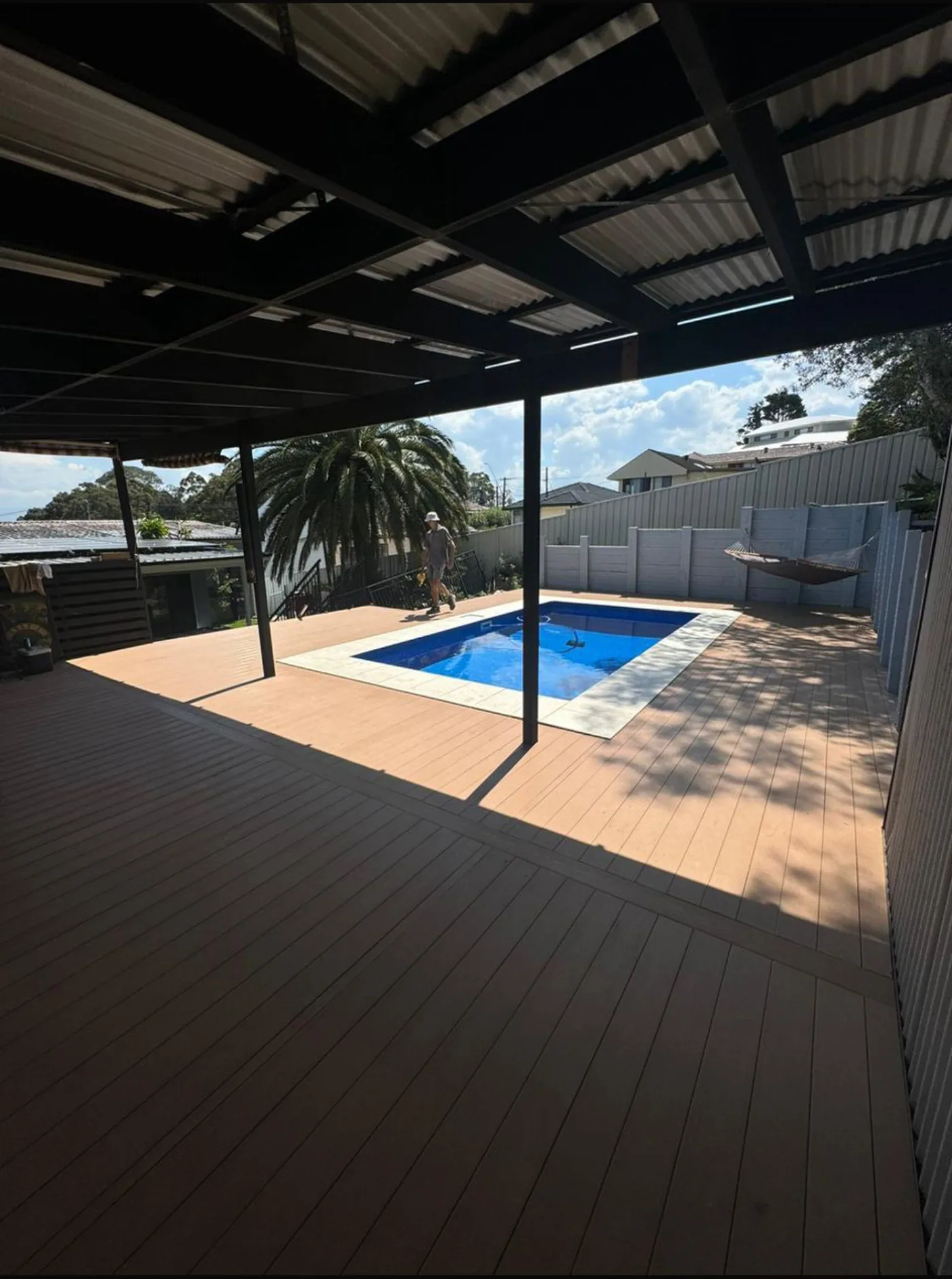
A grey, splintery deck looks like a write-off. Most of the time it isn't.
The boards cop all the blame because they're the bit you see and the bit you walk on. They're also the cheapest, easiest part to swap. What actually decides repair-or-rebuild is the gear you don't look at: the bearers, joists and posts underneath, and where those posts meet the ground. Get under there first.
We do both ends of this round the Illawarra. Re-board and re-oil one week, full tear-down and rebuild the next. Doesn't matter to us which one you need — so here's how to tell which one you've actually got.
Can an old timber deck be repaired, or does it have to be replaced?
Most old decks can be repaired rather than replaced. The boards take all the wear and all the blame, and they're the cheapest part of a deck to swap, so a surface that looks finished from above is usually a re-board and a re-oil.
The frame decides it, not the surface. If the bearers, joists and post bases still stop a screwdriver dead, you're repairing. If they take the tip, or the posts were rammed into soil instead of sat on stirrups, new boards would be going onto something that's already failing, and that's a replacement.
A few rotten boards on their own are always a repair. Cut the bad length out over the joists either side, splice a new board in, and match the fixings so it doesn't streak rust down the good timber. The bad ones turn up in the same three spots around here: the shaded south side, under a planter box, and beside a downpipe. Fix the reason before the board or you'll be back doing the next one along.
What does a deck repair involve?
A deck repair means lifting the boards that have had it, checking the bearers, joists and post bases while the frame is open, swapping any joist that's gone soft, then re-boarding and re-fixing the top. On a sound frame it's days of work rather than weeks, and it often comes in at less than half a rebuild.
It's usually fewer boards than people expect. A rotten board gets cut out over the joists either side and a new length spliced in, so nobody's replacing a whole deck because three boards beside the downpipe went. Whatever caused those three to rot gets sorted at the same time, or you'll be back in two years doing the next one along.
The two things worth dealing with while the boards are up are the fixings and the post bases. Salt air off the water eats cheap screws and post brackets long before it touches the timber, and a post rammed into soil instead of sitting on a stirrup is the number one reason decks fail around here. Both are straightforward with the deck open and a proper job once it's closed up again.
Then it's a sand, two coats of decking oil, and a shake of the balustrade before we leave.
Deck restoration or full reconstruction: what's the difference?
A restoration keeps the existing frame and renews everything sitting on top of it. A reconstruction takes the deck back to the footings and starts again, posts and all.
There are really three scopes and they're worth naming, because quotes get compared across them without anyone noticing. A refurb is the lightest: clean it back, sand it, replace popped or rusted fixings, two coats of oil. Days, not weeks, and the deck keeps every piece of timber it already had. A restoration goes further and re-boards the top on the frame that's already there, swapping the odd joist that's gone but leaving the structure in place. A reconstruction is new footings, posts, bearers, joists and boards, which is a new deck on the old footprint.
Cost follows that ladder fairly closely. A rebuild gets priced by the square metre, roughly $350 to $500 per square metre in treated pine and $500 to $750 in merbau or spotted gum, which is the working I've set out in the deck cost guide. A restoration on a sound frame comes in well under that because the expensive, slow half of the job is already built and standing. What a deck repair costs breaks that ladder down by scope, from a re-oil through to frame work.
Back decks are where this comes up most around here. They're the oldest part of half these houses, they cop the weather off the escarpment, and they're usually the bit that got built by somebody's uncle in a weekend.
Get under it before you decide anything
Pop your head under the deck, or pull a board up if it's low to the ground. You're looking at the frame, not the surface.
Push a screwdriver into the bearers and joists. Hit the ends and anywhere that stays damp — under a planter box, beside a downpipe, the shady south side that never dries out. Sound timber stops the tip dead. If it sinks in like cheese, or you can flick out wet stringy fibres, that's rot. Don't panic over surface checking and grey — that's just weathering. Soft, punky timber is the problem.
Then the posts, where they go into the ground or into a footing. This is the number one spot decks fail around here. The older ones out on the sloping blocks around Figtree and west of the Gong are the worst — the bottom of the post sits in damp soil for years and there's no air to it. A post should land on a stirrup or galv bracket that holds the timber up off the concrete, not be rammed straight into the dirt. Buried posts rot from the inside. You won't see it. Give one a solid shove and if it shifts, there's your answer.
Give the whole frame a wobble. A deck that sways or bounces when you jump on it has undersized joists, dodgy bracing, or connections that have let go.
The rule of thumb: if the frame is sound and it's mostly the boards that have had it, you're in repair territory. If the bearers, joists or post bases are rotten, no amount of new decking will save it — you'd be screwing nice new boards onto a frame that's on the way out. That's a rebuild.
When it's just the boards (the good news)
This is the common one. It's a fraction of the cost of starting again.
If the frame checks out, we lift the old boards, swap any joist that's seen better days, and re-board the top. Merbau and spotted gum are the usual picks around here — they cop the coast and they look the part. Treated pine if the budget's tight. Composite (the wood-plastic boards) is worth a look if you never want to sand and oil again, though you'll pay more up front and, honestly, some of it still looks like plastic up close.
While the boards are off, that's the moment to sort the fixings and flashing properly. More on that below.
A re-board and re-oil on a good frame usually runs well under a full rebuild — often less than half, depending on the size, the timber and how easy it is to get gear in. Days of work, not weeks. So if your deck looks tired, is going grey, has a few cupped or split boards and the odd popped nail but it's rock solid underfoot, don't let anyone tell you the lot has to come out.
A clean, a sand and a couple of coats of decking oil will bring merbau and spotted gum right back. They go silver-grey when they're neglected, not rotten. That colour washes and oils straight off.
Salt air, fixings and the safety stuff
Here's what bites people near the coast. It's the fixings, not the timber.
Salt air off the water chews through cheap nails and screws. We've pulled decks apart at Thirroul, Austinmer and down the Shoalhaven where the boards were dead fine but every fixing had rusted to a black stain, the screws snapped off in your hand, and the bracket holding a post up had rusted clean through. Anywhere within a few kays of the surf — Helensburgh down to Nowra — wants proper stainless or heavily galvanised fixings and post brackets. The standard gear just won't last in that air.
Black rust streaks running down the boards are a tell the original build skimped on fixings. Worth pricing a re-fix even when the timber's holding up.
Last thing we always check is the balustrade. If your deck floor sits more than one metre above the ground, you need a compliant balustrade or handrail — and the gaps generally can't let a 125mm ball through, so a kid can't slip between the rails or get a head stuck. Loads of older Illawarra decks went up before that mattered, or have dropped below standard since as the timber's shrunk and the rails have worked loose. Wobbly, rotten at the posts, gaps you could post a footy through? That's not a cosmetic job. It's the bit that stops someone going over the edge. We sort these out most weeks and it's usually not a big spend.
So get underneath, test the frame and the post bases, eyeball the fixings, give the balustrade a shake. Sound frame, you restore. Rotten frame, you rebuild. More often than not it's better news than the top of the deck lets on.
Still not sure which one you've got? Either way it's covered under deck repairs. Dave'll come have a look and tell you straight — no charge for the quote, and you won't get sold a rebuild you don't need. Give us a bell on 0414 007 351 or send through the contact form and we'll sort a time.
Want a hand with this at your place? Get a free quote or call 0414 007 351.