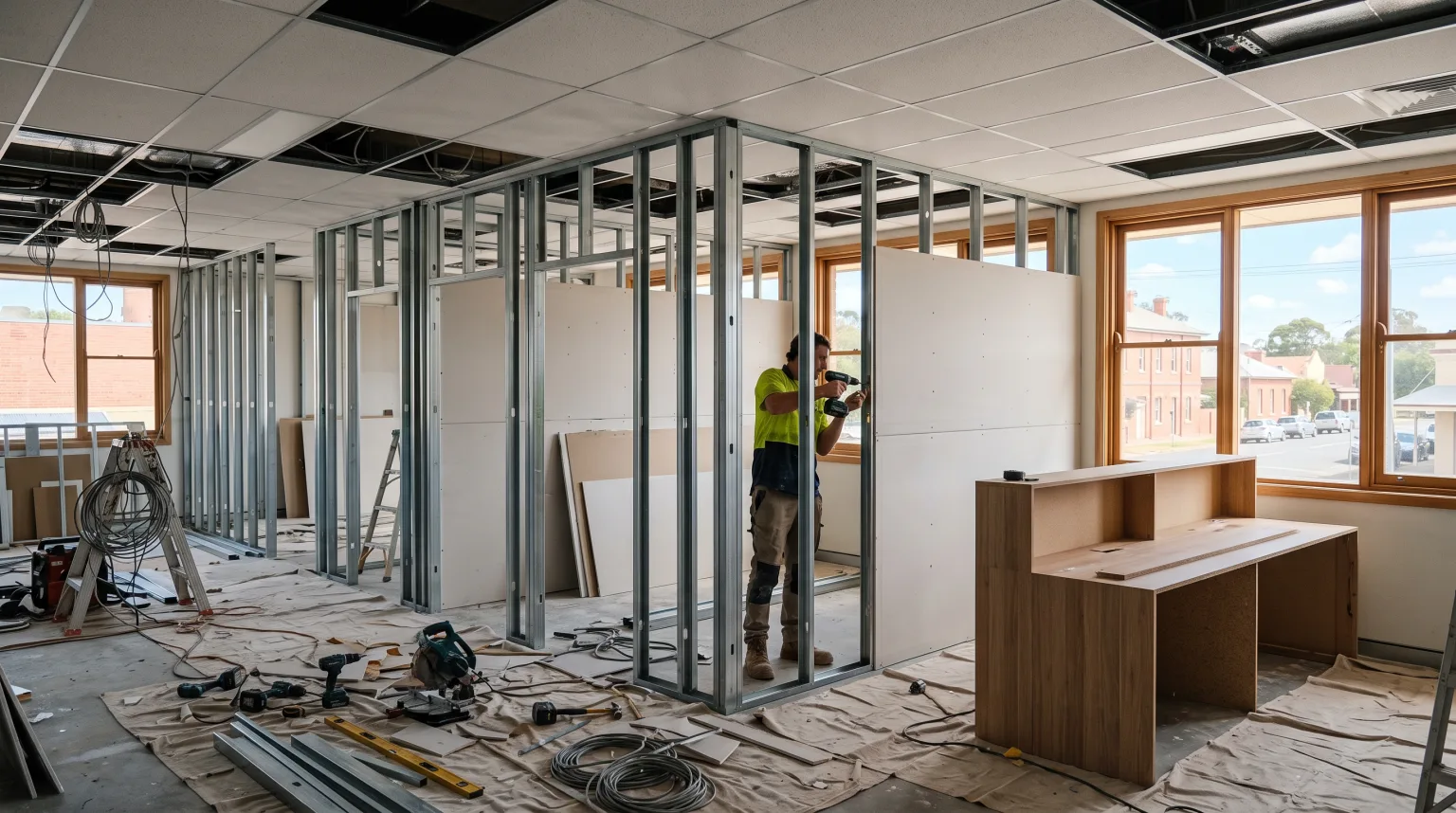
An accountancy practice took a first-floor space off Burelli Street last year. Open plan, one meeting room, decent light, and a floor plan from their designer showing six individual offices and a boardroom.
They'd budgeted for the joinery. Reception desk, some storage, a kitchenette. What they hadn't counted was doors. Six offices meant six door openings, six frames, six sets of commercial-grade hardware, and six places where a partition had to meet a ceiling grid it wasn't designed to meet. The doors and the walls around them came to more than the joinery did, and the joinery was the bit they'd been worrying about.
That's offices, basically. A shop fitout is a counter and some shelving. An office fitout is walls.
What does an office fitout cost in Wollongong?
For a professional office around Wollongong and the Illawarra in 2026, whole job, all trades, the range is $1,200 to $2,500 a square metre. That's partitions to make meeting rooms, decent joinery, new flooring, and data and power reworked to suit where people are actually sitting.
A 150m² tenancy at that rate is somewhere between $180,000 and $375,000, which is a number that makes people put the phone down. Most offices round here land in the lower half of it, and second-generation space — a tenancy that was already an office — lands lower again for reasons I'll get to. I've set out the wider table, retail and hospitality included, in the shop fitout cost post, because the per-square-metre bands only make sense next to each other.
The bit worth understanding before you compare a single quote to anything is that the carpentry is maybe a third of it. On a $150,000 fitout my line might be $35,000 to $50,000. A builder's price with every trade in it and a chippy's price for the walls and joinery are not the same kind of number, and people lay them side by side on a desk all the time.
Where the carpentry money goes
Partitions. That's the answer for nearly every office.
Stud walls to carve up an open tenancy run $180 to $400 a square metre of wall, framed, lined both sides and set. Sounds cheap until you measure it. A single 3-metre-high partition 5 metres long is 15 square metres of wall, and an office layout with six rooms in it has a lot of 5-metre walls. Glazed sections push the rate up. So does insulation, and in an office you want insulation, because the whole reason for the wall is that the conversation on one side shouldn't be audible on the other.
While we're there: a partition that stops at the ceiling grid does almost nothing for sound. It looks like a wall and performs like a curtain, because the noise goes straight up over the top and back down the other side through the tiles. If the room is for performance reviews or client files, the wall goes to the slab. That costs more and it's the difference between a meeting room and a meeting-room-shaped area.
Reception desks are $3,000 to $9,000 built on site, depending on size, shape and what's going on the face. Everyone wants a curve. Curves cost more than straight runs, and I say that at the quote rather than after.
Storage and display joinery is $400 to $1,200 a lineal metre, and the spread is entirely about material and load. Painted MDF at the bottom of it, a decent laminate or spotted gum at the top. An office that's storing paper files rather than showing off a product can usually sit at the cheaper end and nobody notices.
Then doors, which is where the Burelli Street job came unstuck. In a house a door is a door. In an office it's a frame that has to tie into a stud partition, commercial hardware rated for a few hundred cycles a day, and often a closer. Six of them adds up quietly while you're looking at the reception desk.
Refurbishment, or the full thing
A fair few of the calls I get aren't fitouts at all. They're a business that's been in the same space eight years, the walls are marked, the carpet's gone, two of the offices are in the wrong spot and nobody likes reception.
That's a refurbishment, and it's a completely different budget. You keep the services where they are, keep the toilets, keep most of the partitions, move one or two walls, replace the joinery that's tired and repaint the lot. I've done these over a long weekend and a week of evenings, with the business trading on the Monday.
The same logic applies to taking over someone else's office. Second-generation space — a tenancy that was an office before you and is an office after you — is the cheapest fitout going, because the data cabling, the power layout, the lighting and often half the partitions already suit the use. If you're choosing between two tenancies and one of them was already an office laid out roughly how you'd want it, that's worth more than a slightly better rent. Genuinely. I've watched people sign the cheaper lease and spend the difference three times over in the first six weeks.
The parts that aren't carpentry and cost more than it is
Services. Nearly always services.
An older building through the centre of town with a board that's already loaded, and a plan involving a proper comms rack and a kitchenette with a dishwasher, might need an upgrade at $8,000 to $40,000 before anyone hangs a sheet of plasterboard. You don't know until a sparky has looked in the cupboard.
Then compliance. A commercial fitout has to meet the National Construction Code, and the parts that bite small tenants are accessibility, exits and fire separation. An accessible toilet where there wasn't one is $15,000 to $30,000 in a tight space. Path-of-travel widths can eat floor area you were planning to put desks on, which is a nasty one to find out about after you've counted how many people fit.
Get a certifier looking at the drawings early. Changes are cheap on paper and expensive in plasterboard, and I've pulled walls down that were three days old because nobody asked first.
The lease clock, and the clause you'll forget
Two things in the lease decide whether this hurts.
The fitout period is the rent-free stretch the landlord gives you to build in, commonly four to eight weeks. Go over it and you're paying rent on an office nobody's working in. That's why I bang on about programs. A week late on a deck is an annoyance. A week late on a fitout has a dollar figure attached and you'll be the one paying it.
The make-good is the other one, and it's the one nobody reads. At the end of the lease you hand the space back in whatever condition the clause spells out, and they vary wildly — bare shell with everything stripped and the walls patched, or tenantable with the fitout left in place. Budget $10,000 to $50,000 for a make-good on a typical Illawarra tenancy. It turns up five years later at the exact moment the business is moving or winding down, and by then there's nothing to do about it. The NSW Small Business Commission has readable material on commercial leases and they handle the disputes when they go bad.
Read the make-good before you sign, not before you leave.
Doing it while people are still working
Most office fitouts I do are in occupied space, which changes the job more than the drawings do.
Framing and setting plasterboard is dusty and loud. Nobody's taking a client call three metres from that. So it's either a staged job where one end of the floor gets sheeted while the other end works, or it's evenings and weekends, and evenings cost more because the building charges for after-hours access and everyone's rate goes up. Neither is wrong. It just has to be decided at quoting time rather than discovered in week two.
The Burelli Street one we did in two stages. Three offices and the boardroom over a fortnight while they crammed into the open plan, then the other three offices and the reception while the first lot moved in. The doors still cost what the doors cost.
That's the commercial fitout end of what we do, and the partitions and framing side of it is most of the work on an office. Got a tenancy, a floor plan and a lease clock running? Ring Dave on 0414 007 351 or send through the plan and I'll price the carpentry properly and tell you what else you're going to be up for.
Want a hand with this at your place? Get a free quote or call 0414 007 351.